Article Overview
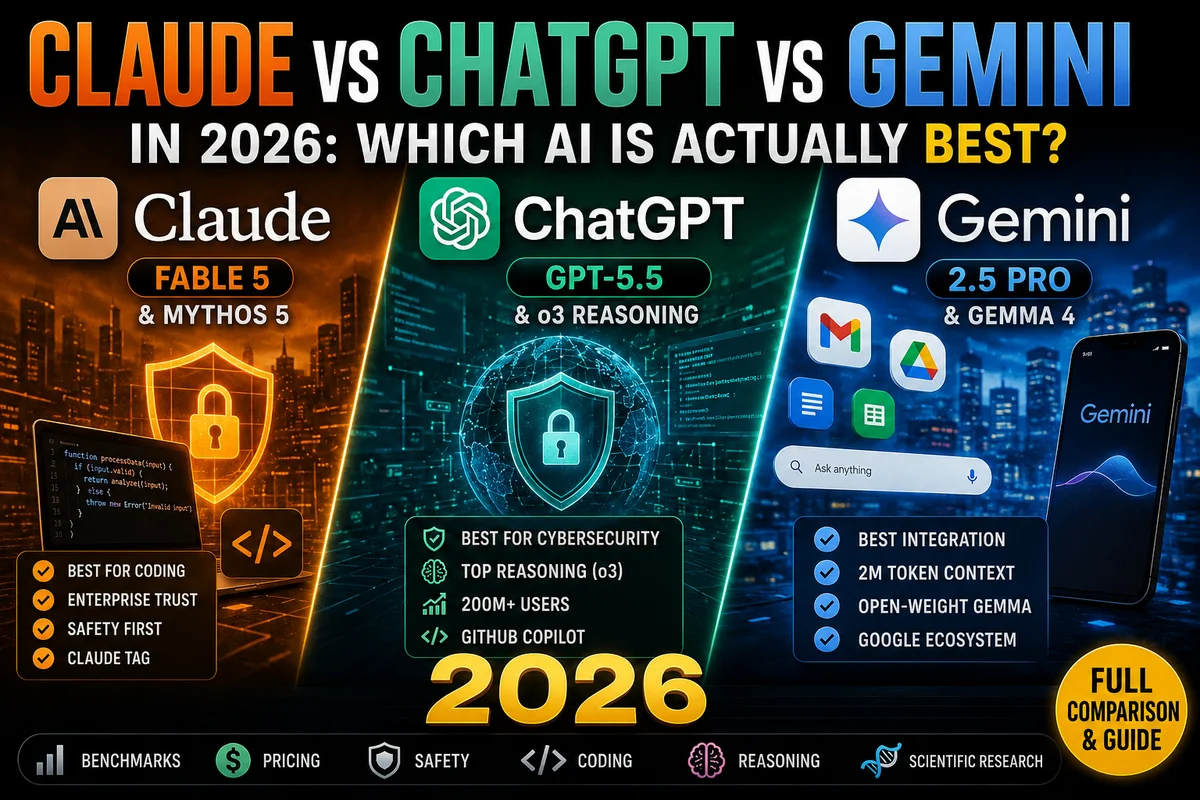
Claude just got its biggest upgrade ever with Fable 5, a model so capable that Anthropic had to build an entirely new safety system just to release it safely. ChatGPT quietly became something closer to a cybersecurity command center than a chatbot, with a platform called Daybreak now patching real vulnerabilities in Firefox and the Linux kernel. Gemini has spent the last year embedding itself so deeply into Google's ecosystem that millions of people are using it without even realizing they switched from a regular search.
In this article you will see exactly how these three AI systems compare as of June 30, 2026 — not marketing claims, but actual benchmark numbers across coding, reasoning, cybersecurity, and scientific research. You will find out which one writes better code, which one reasons more reliably, which one is cheaper to run at scale, and which one your specific use case actually needs.
You will also get an honest answer to the question everyone asks but rarely gets answered properly: is there actually a single best AI in 2026, or does the right answer depend entirely on what you are trying to do? Spoiler — it is the second one, and by the end of this article you will know exactly why.
Introduction
A year ago, comparing AI assistants meant comparing chatbots. In mid-2026, it means comparing three increasingly different technology platforms that happen to share a chat interface as their most visible feature.
Claude, built by Anthropic, has positioned itself as the AI you trust with the highest-stakes work — banks, airlines, government cybersecurity, scientific research that could not previously be automated. ChatGPT, built by OpenAI, remains the AI more people use than any other on earth, and has quietly expanded into territory — autonomous vulnerability patching, agentic coding at massive scale — that few outside the security and developer community have fully registered. Gemini, built by Google, has taken the opposite distribution strategy entirely: rather than asking people to visit a new app, it has built itself directly into Search, Workspace, Android, and almost everything else Google already runs.
None of these three companies is standing still long enough for a comparison to stay accurate for more than a few months. But as of June 30, 2026, the picture is clear enough to draw real conclusions — and that is exactly what this article does.
Where Each Company Stands Right Now
Claude — Anthropic's Biggest Leap Yet
On June 9, 2026, Anthropic released Claude Fable 5 — the most capable model it has ever made publicly available. Fable 5 leads on nearly every benchmark Anthropic tested. Stripe, an early testing partner, reported that Fable 5 completed a full migration of a 50-million-line Ruby codebase in a single day — work that would have taken an entire engineering team more than two months.
What makes Fable 5 structurally different from previous Claude releases is the safety system built around it. Three classifiers — covering cybersecurity, biology and chemistry, and model distillation — automatically detect potentially concerning requests and route them to Claude Opus 4.8 instead. This fallback triggers in fewer than 5% of sessions, meaning most users experience Fable 5 at full capability without ever noticing the safety layer exists.
Above Fable 5 sits Claude Mythos 5 — the same underlying model with those safeguards lifted, but accessible only to vetted cybersecurity partners through Project Glasswing and a small group of approved biology researchers. Mythos 5 has accelerated drug design workflows by roughly ten times and conducted autonomous genomics research that outperformed a recently published academic result using a model 100 times smaller.
Two weeks later, on June 23, Anthropic launched Claude Tag — bringing Claude into Slack as a persistent team member rather than a chat window. Anthropic disclosed that 65% of its own product team's code is now written through their internal version of this same system, which is a genuinely unusual thing for a company to say about its own AI publicly.
ChatGPT — Still the Biggest, Now Doing More Than Chat
ChatGPT remains the most-used AI assistant in the world, with more than 200 million weekly active users. But the more significant development in 2026 has happened away from the consumer chat interface entirely.
OpenAI's Daybreak platform has turned GPT-5.5 and a specialized variant called GPT-5.5-Cyber into one of the most capable cybersecurity tools available anywhere. GPT-5.5-Cyber scored 85.6% on CyberGym — the highest score any single model has achieved on that benchmark, ahead of Anthropic's Mythos 5 at 83.8%. Through Daybreak's Codex Security tool, OpenAI has scanned more than 30 million code commits across over 30,000 repositories, with more than 500,000 security findings automatically confirmed fixed. Real vulnerabilities have been found and patched in Firefox, Safari, and the Linux kernel.
On pure reasoning, OpenAI's o3 model remains a genuine milestone — scoring 87.5% on the ARC-AGI benchmark, a test specifically designed to resist AI pattern-matching, against a human baseline of roughly 85%. It was the first time any AI model crossed that line.
GitHub Copilot, built on OpenAI's technology, has over 1.8 million paid subscribers, making it the most widely adopted AI coding tool by raw user count anywhere in the industry.
Gemini — Everywhere, Even When You Do Not Notice
Google's approach with Gemini has never been about getting people to open a new app. It has been about making Gemini the thing that already powers the apps people use constantly anyway.
Gemini 2.5 Pro is Google's current flagship — a "thinking model" with reasoning built into its default behavior rather than offered as a toggle. It topped human-preference leaderboards like LMArena at release and led on real-world coding benchmarks at the time. Its context window stretches up to 2 million tokens in some configurations — among the largest available from any major provider.
Where Google has built something genuinely distinctive is in the breadth of its specialized model portfolio. AlphaFold 3 remains the standard for predicting how proteins and other biological molecules interact — used in legitimate drug discovery research worldwide. Veo 2 generates high-definition video with physically plausible motion. Imagen 3 handles image generation. MedGemini applies Gemini's multimodal capability directly to medical imaging and clinical questions.
Google has also pushed harder than either competitor into open-weight models with the Gemma family, now on its fourth generation. Gemma 4's 31B variant scored 39 on the Artificial Analysis Intelligence Index — well above the median of 15 for models in its size class — giving developers who need to self-host AI a genuinely competitive option.
Head-to-Head: The Benchmarks That Matter
Numbers settle arguments that opinions cannot. Here is exactly how the three companies' leading models compare on the evaluations that matter most.
Cybersecurity — CyberGym
Model | Score |
|---|---|
GPT-5.5-Cyber | 85.6% |
Claude Mythos 5 | 83.8% |
GPT-5.5 | 81.8% |
GPT-5.4 | 79.0% |
Claude Opus 4.7 | 73.1% |
OpenAI currently holds the lead in pure cybersecurity capability, with GPT-5.5-Cyber posting the highest single-model score recorded on this benchmark. Anthropic's Mythos 5 sits close behind — but remember, Mythos 5 is restricted to vetted partners while GPT-5.5-Cyber is available to verified defenders through Daybreak.
General Reasoning — ARC-AGI
OpenAI's o3 reached 87.5% on ARC-AGI, against a human baseline of roughly 85%. This remains the single most cited reasoning milestone in the current generation of AI models, and as of June 2026, no publicly disclosed score from Claude or Gemini has been reported as exceeding it on this specific benchmark.
Scientific Research — LifeSciBench
Model | Pass Rate |
|---|---|
GPT-Rosalind | 36.1% |
GPT-5.5 | 25.7% |
Gemini 3.1 Pro | Evaluated among top performers |
Grok 4.3 | Evaluated |
OpenAI's frontier model leads on this rigorous, expert-validated life science benchmark, though the broader takeaway from LifeSciBench is that no model — from any company — has come close to solving this category. A 36.1% leading score signals genuine room for all three companies to improve here.
Coding Quality — FrontierCode
Claude Fable 5 posted the highest score among all frontier models on Cognition's FrontierCode benchmark, even running at medium computational effort — a result that lines up with the real-world Stripe migration story and suggests Claude currently holds a meaningful edge specifically in production-grade code generation.
Financial Analysis — Hebbia Finance Benchmark
Claude Fable 5 also leads here, with the strongest gains specifically in document-based reasoning and chart interpretation — the kind of work financial analysts and trading firms depend on daily.
Pricing: What You Actually Pay
Tier | Claude | ChatGPT | Gemini |
|---|---|---|---|
Free | Limited Claude access | GPT-4o mini class | Gemini app, Google account |
Mid-tier subscription | Pro plan, monthly fee | Plus, $20/month | Google AI Premium, similar range |
Premium subscription | Max plan, higher tier | Pro, $200/month | Premium tiers via Google One |
API — frontier model | Fable 5 and Mythos 5: $10/M input, $50/M output | Per-token, GPT-5.5 tier pricing | Per-token, Gemini 2.5 Pro tier pricing |
Restricted/frontier-plus | Mythos 5 — vetted access only | GPT-5.5-Cyber — verified defenders only | No equivalent restricted tier disclosed |
The most interesting pricing development of 2026 is Claude Fable 5's $10 per million input token rate — less than half what Anthropic charged for the previous Mythos Preview model. This makes Anthropic's most capable public model meaningfully more affordable than it was just months earlier, narrowing what had been a real cost gap with competitors.
Where Each One Genuinely Wins
No single AI assistant wins every category in 2026. Here is the honest breakdown of where each one actually has the edge.
Claude Wins For:
Production-grade coding at scale. The FrontierCode benchmark lead and the real Stripe migration result point to the same conclusion — Fable 5 is currently the strongest choice for serious software engineering work, particularly on large, complex codebases.
Regulated industries and enterprise trust. The DXC Technology alliance, training tens of thousands of engineers to deploy Claude inside banks, airlines, and insurers, reflects a level of enterprise confidence that takes years to build. Anthropic's Constitutional AI framework and Responsible Scaling Policy give compliance and risk teams something concrete to evaluate, not just marketing language.
Financial and document-heavy analysis. The Hebbia Finance Benchmark lead translates directly into real value for anyone working with dense financial documents, contracts, or multi-table data.
Team collaboration through Claude Tag. No competitor currently offers anything resembling Claude Tag's persistent, multiplayer, ambient presence inside a team's actual workspace.
ChatGPT Wins For:
Cybersecurity and vulnerability remediation. GPT-5.5-Cyber's CyberGym lead, combined with the sheer operational scale of Daybreak's Codex Security tool, makes OpenAI the clear leader for anyone doing serious security work.
Pure reasoning on hard problems. The o3 ARC-AGI result remains the standout reasoning achievement of this generation, and OpenAI's o-series continues to be the most tested option for mathematics, formal logic, and multi-step analytical problems.
Sheer ecosystem reach. Between 200 million weekly ChatGPT users, 1.8 million GitHub Copilot subscribers, and deep Microsoft integration through Azure, no competitor reaches as many people through as many surfaces.
Multimedia generation. DALL-E and Sora give OpenAI the most mature image and video generation suite bundled directly with a leading language model.
Gemini Wins For:
Anyone already living inside the Google ecosystem. If your work happens in Gmail, Docs, Sheets, and Android, Gemini's integration depth means you may already be using sophisticated AI without a separate subscription or app.
Massive context windows. With configurations reaching up to 2 million tokens, Gemini handles the longest documents, largest codebases, and most extensive multi-document analysis tasks more comfortably than either competitor in mainstream deployment.
Open-weight flexibility. Nothing from Anthropic or OpenAI competes directly with Gemma 4 for organizations that need to self-host a genuinely capable model rather than calling an API.
Specialized scientific and creative tools. AlphaFold 3, Veo 2, and Imagen 3 give Google a breadth of purpose-built models that neither competitor currently matches in scientific and creative domains specifically.
The Safety Question: A Real Difference, Not Just Marketing
This is worth addressing directly because it shapes how each company approaches releasing new capability.
Anthropic built a two-tier system specifically because Fable 5 and Mythos 5 crossed a capability threshold the company judged too significant to release without safeguards. The classifiers, the fallback architecture, and the restricted access program for Mythos 5 are not optional add-ons — they are why Fable 5 exists in its current form at all.
OpenAI has taken a comparable approach specifically for cybersecurity with GPT-5.5-Cyber, restricting its most permissive and capable cyber variant to verified defenders while making the more broadly safe GPT-5.5 available to everyone else.
Google has not published an equivalent two-tier restricted access framework for Gemini as of June 2026, though its specialized scientific models like AlphaFold operate under their own usage terms.
The practical takeaway: if your use case touches cybersecurity, biological research, or any domain where misuse carries serious real-world risk, both Anthropic and OpenAI have built specific infrastructure for verified, higher-capability access. This is worth knowing if your work falls into those categories.
So Which One Should You Actually Use?
The honest answer depends entirely on what you need, and pretending otherwise would be dishonest.
If you write code professionally, especially on large or legacy codebases — Claude Fable 5 currently has the strongest demonstrated real-world results, backed by both benchmark performance and the Stripe case study.
If you work in cybersecurity, whether offense or defense — GPT-5.5-Cyber through OpenAI's Daybreak platform is purpose-built for exactly this, with the highest measured capability and an entire ecosystem of security partners built around it.
If you need the absolute best reasoning on hard mathematical or logical problems — OpenAI's o3 remains the most tested option, with the ARC-AGI milestone as concrete evidence.
If your organization operates in a regulated industry like finance, insurance, or healthcare — Claude's enterprise track record, Constitutional AI framework, and the DXC alliance give you the clearest paper trail for compliance and risk teams.
If you are already deep in the Google ecosystem and want AI without switching tools — Gemini's integration across Search, Workspace, and Android means you may get meaningful value with minimal friction.
If you need to process extremely long documents or massive codebases in a single pass — Gemini's larger context window configurations currently offer the most headroom.
If you want to self-host an open-weight model rather than call an API — Gemma 4 is the strongest option among the three companies, since neither Anthropic nor OpenAI currently releases open-weight frontier models.
If you want a true team collaborator rather than a chat window — Claude Tag is currently unmatched, and the fact that Anthropic uses it internally for the majority of its own product code is a genuinely strong signal.
Final Takeaway
Asking "which AI is best" in 2026 is a bit like asking which vehicle is best without knowing whether you need a delivery van, a sports car, or a family sedan. Claude, ChatGPT, and Gemini have spent the past year diverging into genuinely different specialties rather than converging into interchangeable products.
Claude has become the clearest choice for serious software engineering and enterprise trust. ChatGPT has become the most formidable option for cybersecurity and pure reasoning, while still holding the largest user base on earth. Gemini has become the deepest, most frictionless integration into the tools hundreds of millions of people already use every day, alongside the strongest open-weight alternative for anyone who wants to self-host.
None of these companies is finished. Each will likely release something that shifts at least part of this comparison within months. But as of June 30, 2026, the picture is clear: there is no single best AI. There is only the best AI for what you are actually trying to do — and now you know exactly which one that is.