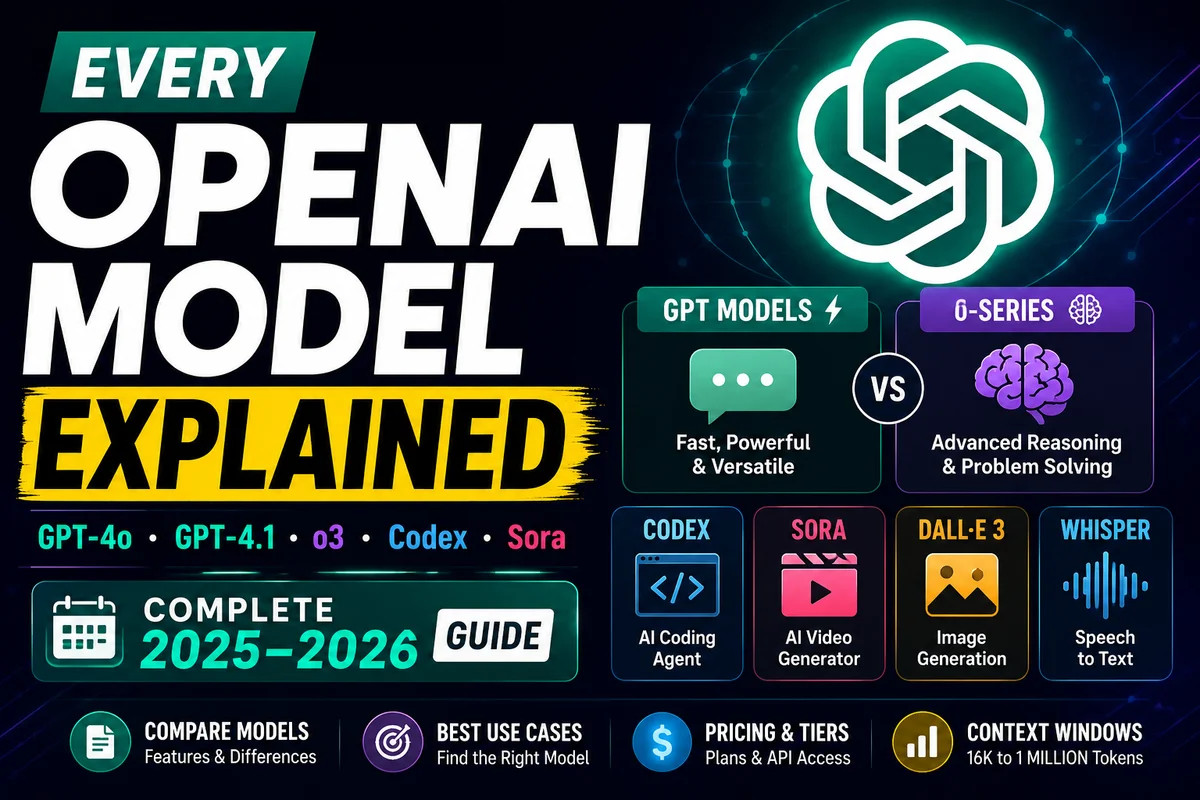
OpenAI now has more models than most people can track — two completely different model families, multiple size tiers within each, specialized tools for video, voice, images, and code. Here is every model, what it does, and exactly how they differ from each other.
Introduction
When ChatGPT launched in late 2022, the model powering it was GPT-3.5 Turbo. The choice was simple: one model, one interface, one capability level.
By mid-2025, OpenAI's lineup spans two fundamentally different model architectures, five distinct size tiers, context windows ranging from 16,000 to one million tokens, and a growing family of specialized models for video, audio, images, and code. Picking the right one requires understanding not just the names but the underlying logic of why each model exists.
This guide covers every OpenAI model worth knowing — GPT-4o, GPT-4.1, GPT-4.5, the entire o-series, Codex, Sora, Whisper, DALL-E 3, and more. What each one is built for, how it compares to the others, and where it belongs in a real workflow.
The Most Important Distinction First: Two Model Families
Before diving into individual models, one distinction separates the entire OpenAI lineup into two fundamentally different categories.
The GPT family — GPT-4o, GPT-4.1, GPT-4.5, GPT-3.5 Turbo — are generalist models. They respond quickly, handle text, images, audio, and code, and are designed for broad, conversational, and production use. They do not stop to think. They generate responses fluidly and fast.
The o-series reasoning models — o1, o3, o4 mini, o3 pro — work differently. Before answering, they run an internal chain of thought. They reason through the problem step by step, which takes more time and costs more compute, but produces dramatically better results on tasks that require logic, mathematics, science, and complex coding. Think of GPT models as fast and broad; o-series models as slow and deep.
Understanding this split makes every other choice in the OpenAI lineup easier.
The Full OpenAI Model Lineup at a Glance
Model | Family | Context Window | Best For | Key Trait |
|---|---|---|---|---|
GPT-3.5 Turbo | GPT | 16K | Legacy apps, simple tasks | Original ChatGPT model |
GPT-4 | GPT | 8K to 32K | General reasoning | First GPT-4 generation |
GPT-4 Turbo | GPT | 128K | Long documents, instruction tasks | 128K context breakthrough |
GPT-4o | GPT | 128K | Multimodal, real-time voice | Native text, image, and audio |
GPT-4o Mini | GPT | 128K | Affordable vision and text | Replaced GPT-3.5 as default budget model |
GPT-4.5 | GPT | 128K | Nuanced conversation | Largest GPT, emotional intelligence |
GPT-4.1 | GPT | 1,000,000 | Long context, coding | One million token window |
GPT-4.1 Mini | GPT | 1,000,000 | Cost-effective long context | 1M context at mid-range price |
GPT-4.1 Nano | GPT | 1,000,000 | High-volume, ultra-fast apps | Cheapest 1M context model |
o1 Preview | o-series | 128K | Early reasoning access | First public reasoning model |
o1 | o-series | 128K | Math, science, coding | Full chain-of-thought release |
o1 Mini | o-series | 128K | Fast coding and math | Affordable targeted reasoning |
o1 Pro | o-series | 128K | Hardest reasoning tasks | Max compute, Pro tier only |
o3 Mini | o-series | 200K | Efficient scalable reasoning | Three selectable effort levels |
o3 | o-series | 200K | Frontier-level reasoning | First AI above human ARC-AGI score |
o4 Mini | o-series | Not publicly specified | Vision plus reasoning, affordable | First mini reasoner with image input |
o3 Pro | o-series | 200K | Maximum reasoning power | Extended thinking, Pro tier only |
Part One: The GPT Family
GPT-3.5 Turbo
Released: 2022 Context: 16K tokens API string: gpt-3.5-turbo
The model that started it all. GPT-3.5 Turbo powered the original ChatGPT and introduced hundreds of millions of people to conversational AI. Fast, affordable, and surprisingly capable for its time, it became the default choice for developers building cost-sensitive applications.
By mid-2024, GPT-4o mini had surpassed it in both capability and cost-effectiveness, and GPT-3.5 Turbo moved into legacy territory. Most applications that were running on it have since migrated — but it remains available and perfectly serviceable for simple classification, summarization, and retrieval tasks where cost is the primary constraint.
GPT-4
Released: March 2023 Context: 8K tokens (32K version available) API string: gpt-4
The first GPT-4 generation was a watershed moment. The capability gap between GPT-3.5 and GPT-4 on complex reasoning tasks was immediately obvious — GPT-4 could follow multi-step instructions more reliably, write more coherent long-form content, and handle nuanced tasks that GPT-3.5 consistently fumbled.
GPT-4's original context window of 8,000 tokens was a meaningful limitation. The 32K context version helped, but the real context breakthrough came with GPT-4 Turbo. GPT-4 remains the historical reference point — the model that established what GPT-4 generation intelligence looks like before all subsequent refinements.
GPT-4 Turbo
Released: November 2023 (updated April 2024) Context: 128K tokens Knowledge cutoff: April 2024 API string: gpt-4-turbo
GPT-4 Turbo solved the context window problem that constrained GPT-4. At 128,000 tokens, it could process entire books, lengthy legal documents, or large codebases in a single pass — something that previously required chunking and external retrieval logic.
Beyond context, GPT-4 Turbo improved instruction following, added a JSON mode for structured outputs, and came in cheaper than the original GPT-4. The April 2024 update added vision capabilities, bringing image understanding into the same model. For enterprise applications requiring deep document analysis, GPT-4 Turbo was the standard-bearer until GPT-4o arrived.
GPT-4o — The Omni Model
Released: May 2024 Context: 128K tokens API string: gpt-4o
The "o" in GPT-4o stands for omni — all modalities in one model. For the first time, text, image, and audio lived inside a single unified model rather than being patched together from separate components. This was not just a feature addition — it changed how the model handled multimodal inputs, enabling more natural integration between different types of information.
GPT-4o was also faster and cheaper than GPT-4 Turbo, making it the obvious default choice for most applications at launch. OpenAI deployed it as the standard ChatGPT model for Plus subscribers and eventually for free users as well.
The Realtime API, introduced alongside GPT-4o, enabled low-latency audio input and output — the foundation for voice assistant applications that could hold natural conversations without the stuttering delays of earlier approaches. Multiple snapshot versions followed across 2024, each bringing refinements to performance and output quality.
GPT-4o Mini
Released: July 2024 Context: 128K tokens API string: gpt-4o-mini
GPT-4o mini did something important: it made GPT-4 generation intelligence genuinely affordable. Its predecessor in the affordable tier, GPT-3.5 Turbo, had been the go-to cheap model for years — but it was built on older architecture and lacked vision capabilities. GPT-4o mini replaced it with a model that supports image inputs, handles 128K context, and delivers meaningfully better performance at a cost that still works for high-volume applications.
For developers building customer service bots, document processing pipelines, content classifiers, or any application where per-call cost matters, GPT-4o mini became the natural default in the second half of 2024.
GPT-4.5
Released: February 2025 Context: 128K tokens API string: gpt-4.5-preview
GPT-4.5 occupies an unusual position in the lineup. It is the largest and most expensive non-reasoning GPT model, but its headline improvement is not raw intelligence — it is the quality of conversation itself. OpenAI described it as having improved emotional intelligence, better understanding of subtle intent, and more natural responsiveness to nuanced instructions.
For tasks that benefit from fluid, contextually aware dialogue — coaching tools, customer engagement, creative collaboration — GPT-4.5 represents the peak of the conversational GPT tier. But it is not designed for high-volume use. For pure reasoning tasks, the o-series models outperform it by a wide margin. GPT-4.5 is the right choice when conversation quality matters more than analytical depth or processing volume.
GPT-4.1 — The One Million Token Model
Released: April 2025 Context: 1,000,000 tokens API string: gpt-4.1
GPT-4.1 crossed a threshold that changed what large language models can practically do with long documents. One million tokens — roughly 750,000 words, or several full-length novels — fits in a single context window. The implications are significant for any application working with large codebases, extensive research archives, lengthy legal contracts, or multi-document analysis that previously required complex retrieval-augmented generation pipelines.
Beyond context, GPT-4.1 brought major improvements in coding and instruction following, and was priced more competitively than GPT-4o for API users. It launched as an API-only model, positioned specifically for developers and enterprise workflows.
GPT-4.1 Mini
Released: April 2025 Context: 1,000,000 tokens API string: gpt-4.1-mini
The same one-million-token context window as GPT-4.1, at a lower cost. GPT-4.1 mini is the answer for applications that need extended context but cannot absorb full GPT-4.1 pricing at scale. Strong coding performance for its tier and a solid choice for production pipelines that process large documents frequently.
GPT-4.1 Nano
Released: April 2025 Context: 1,000,000 tokens API string: gpt-4.1-nano
The smallest, fastest, and cheapest model in the GPT-4.1 family — and the most cost-effective way to access a one-million-token context window. GPT-4.1 nano is built for applications where latency and per-call cost are critical constraints and the task does not require deep reasoning. Real-time summarization, document triage, quick classification, and high-frequency automation tasks are where it earns its place. The fact that it carries the same one-million-token context as its larger siblings is what makes it genuinely useful rather than just a stripped-down option.
Part Two: The o-Series — OpenAI's Reasoning Models
The o-series is a different kind of model. Every model in this family uses internal chain-of-thought reasoning — working through a problem step by step before delivering a final answer. This takes more time and costs more compute than a standard GPT response, but for problems requiring mathematical precision, logical consistency, or complex multi-step planning, the quality difference is significant.
o1 Preview
Released: September 2024 Context: 128K tokens
The first public glimpse of what reasoning models could do. o1 preview gave developers and researchers early access to chain-of-thought reasoning capabilities — demonstrating on standardized benchmarks that a model spending time thinking before answering could outperform PhD-level specialists in certain scientific domains. The preview was deliberately limited in features, but the capability signal was clear enough to reshape how the AI industry thought about what language models could achieve.
o1
Released: December 2024 Context: 128K tokens API string: o1
The full o1 release expanded on the preview with improved performance and broader availability. On competition mathematics benchmarks, o1 competed with top human performers — a category that GPT-4o and similar models had previously handled poorly. On science evaluations requiring expert-level knowledge and multi-step reasoning, o1 outperformed PhD-level specialists on specific domain tests.
o1 is not the model for quick tasks. It is significantly slower than GPT-4o and more expensive. The right use case is a problem where getting the answer right matters more than getting it fast — formal proofs, scientific reasoning, complex debugging, financial modeling with multiple interdependencies.
o1 Mini
Released: September 2024 Context: 128K tokens API string: o1-mini
A faster, cheaper version of o1 optimized specifically for coding and mathematical reasoning. o1 mini trades some of o1's broad knowledge for speed and cost efficiency on targeted technical tasks. For developers building coding assistants or math tutoring tools who need reasoning quality but cannot absorb full o1 costs at production scale, o1 mini was the practical middle ground — until o3 mini superseded it.
o1 Pro
Released: December 2024 Access: ChatGPT Pro ($200/month) initially Context: 128K tokens
o1 pro allocates significantly more compute to the thinking process, making it the strongest reasoning model OpenAI offered at its launch. The additional thinking time translates to better performance on the hardest problems. It launched exclusively on the $200/month ChatGPT Pro plan, reflecting both its cost to run and its positioning as a tool for professionals with serious technical demands.
o3 Mini
Released: February 2025 Context: 200K tokens API string: o3-mini
o3 mini introduced an important design feature: three selectable reasoning effort levels — low, medium, and high. This lets developers tune the tradeoff between speed, cost, and output quality for each request rather than accepting a fixed compute budget. A low-effort call is fast and cheap. A high-effort call takes longer but works through harder problems more thoroughly.
The 200K token context window combined with competitive cost made o3 mini the practical replacement for o1 mini across most production use cases. Strong coding performance at lower cost than o3 made it a popular choice for developer tools in early 2025.
o3
Released: April 2025 Context: 200K tokens API string: o3
o3 is the full-scale reasoning model and the most significant milestone in OpenAI's reasoning model line. On the ARC-AGI benchmark — a test of general problem-solving ability that measures adaptability rather than memorized knowledge — o3 scored 87.5%. The human baseline on the same benchmark sits at approximately 85%. This was the first time an AI model had crossed the human performance threshold on a test specifically designed to resist AI pattern-matching.
On competition mathematics benchmarks, o3 scores above the 99th percentile of human participants. On SWE-bench verified, which tests AI performance on real software engineering tasks, o3 ranks among the strongest available models.
The tradeoff is cost and speed. o3 on high-compute settings is expensive to run. It is built for the problems where that investment is justified: complex scientific reasoning, formal verification, advanced software engineering, research synthesis requiring multi-step logical chains.
o4 Mini
Released: April 2025 API string: o4-mini
o4 mini arrived alongside the GPT-4.1 family and quickly became one of OpenAI's most practically useful models. Two things distinguish it from its predecessors in the mini reasoning tier.
First, vision capability — o4 mini is the first mini-class reasoning model that can process images. This means it can reason over charts, diagrams, screenshots, and visual data rather than just text, opening up categories of tasks previously limited to larger and more expensive models.
Second, performance-to-cost ratio — o4 mini delivers reasoning quality that surprised many developers given its cost tier. For coding, mathematics, and science tasks, it consistently outperforms what its price point would suggest. For applications that need reasoning quality without full o3 costs, o4 mini became the default recommendation almost immediately after release.
o3 Pro
Released: June 2025 Context: 200K tokens Access: ChatGPT Pro and API
The current peak of OpenAI's reasoning model lineup. o3 pro allocates extended thinking time to work through the most difficult problems available — the category of tasks where even o3 produces inconsistent results and where maximum compute actually changes the outcome. For research applications, advanced mathematical work, and the hardest software engineering challenges, o3 pro represents the ceiling of what OpenAI's reasoning architecture can currently deliver.
Part Three: Specialized Models
Codex — The AI Coding Agent
Original release: 2021 Current version: 2025–2026
The original Codex powered GitHub Copilot and introduced AI code completion to millions of developers. The modern Codex is a fundamentally different product — a cloud-based agentic coding system that runs code in isolated sandboxes, can write entire features from a description, tests its own output, debugs failures, and executes tasks in parallel across multiple workstreams.
Codex is not just a code completer. It is an autonomous coding collaborator — used by researchers to derive novel mathematical algorithms, deployed by enterprises through cloud partnerships including Oracle Cloud Infrastructure, and available directly through the OpenAI API and ChatGPT interface.
DALL-E 3 — Image Generation
Released: October 2023 Access: ChatGPT, API
DALL-E 3 was a substantial leap over its predecessor in one specific area: following instructions accurately. Earlier image generation models often failed to render specific details, missed requested elements, or distorted text inside images. DALL-E 3 addressed these failures through tight integration with a language model that interprets and clarifies prompts before passing them to the image generator.
The result is a model that creates images much closer to what users actually describe. It is integrated directly into ChatGPT and available through the OpenAI API for developers building image generation into applications.
Sora — Video Generation
Announced: February 2024 Released: December 2024 Access: ChatGPT Plus and Pro
Sora generates video from text descriptions — up to 60 seconds of footage with remarkable consistency across frames. The technical challenge in video generation that previous models struggled with was temporal coherence: objects would change shape, characters would shift appearance, and physics would behave inconsistently between frames. Sora maintains scene consistency in ways that mark a genuine step forward for the field.
At launch, Sora was available to ChatGPT Plus and Pro subscribers and was not accessible through the standard API. It is positioned as a creative tool for video professionals, content creators, and developers building video-centric applications.
Whisper — Speech to Text
Released: September 2022 Access: Open source and OpenAI API
Whisper is OpenAI's speech recognition model, available open source in five sizes — tiny, base, small, medium, and large — allowing deployment at different resource levels. It handles multiple languages, performs well on accented speech, and produces accurate transcriptions across a wide range of audio quality levels.
Widely used in transcription pipelines, meeting summarization tools, voice interfaces, and accessibility applications.
TTS — Text to Speech
API strings: tts-1 and tts-1-hd
Two variants with different quality-latency tradeoffs. tts-1 prioritizes low latency for real-time applications such as voice assistants and interactive tools. tts-1-hd produces higher-quality audio suitable for recorded content and audiobook narration. Six voice options are available across both variants.
Embeddings — Semantic Understanding
API strings: text-embedding-3-small, text-embedding-3-large, text-embedding-ada-002
Embedding models convert text into numerical vectors that encode semantic meaning. The practical application is search and retrieval: instead of matching exact keywords, systems using embeddings can find documents that are conceptually similar to a query even when the wording differs entirely. This is the foundation of most RAG pipelines, semantic search engines, recommendation systems, and content clustering tools.
text-embedding-3-large delivers higher precision at higher cost. text-embedding-3-small is more cost-efficient for large-scale indexing. text-embedding-ada-002 is the older generation, still functional but generally superseded by the 3-series.
Moderation Models
API strings: omni-moderation-latest, text-moderation-latest Cost: Free
OpenAI provides moderation models at no charge to help developers classify content for potential policy violations — covering hate speech, violence, self-harm, and sexual content. omni-moderation-latest handles both text and images. Typically used as a filtering layer in production applications handling user-generated content.
How Context Windows Changed Everything
Era | Model | Context Window |
|---|---|---|
Early ChatGPT | GPT-3.5 Turbo | 4K to 16K tokens |
GPT-4 launch | GPT-4 | 8K to 32K tokens |
Turbo era | GPT-4 Turbo | 128K tokens |
Multimodal era | GPT-4o, o1, o3 | 128K to 200K tokens |
Current milestone | GPT-4.1 family | 1,000,000 tokens |
The leap from 128K to one million tokens changes the category of tasks a model can handle without external tooling. A one-million-token window fits roughly 750,000 words — enough to hold entire software repositories, full legal case histories, or multi-year financial records in a single session. Applications that previously required complex RAG pipelines can now load entire corpora directly.
Reasoning Models vs GPT Models: When to Use Which
Task Type | Best Choice | Why |
|---|---|---|
Quick answers, summarization, writing | GPT-4o or GPT-4.1 | Fast, broad, cost-effective |
Customer service, chatbots at volume | GPT-4o Mini or GPT-4.1 Mini | Speed and affordability at scale |
Complex production coding | o3 Mini or o4 Mini | Reasoning catches more edge cases |
Competition math or formal proofs | o3 or o3 Pro | Chain-of-thought is essential |
Long document analysis | GPT-4.1 with 1M context | Entire documents fit in one pass |
Scientific research or hypothesis work | o3 or o3 Pro | Multi-step logical reasoning required |
Real-time voice interaction | GPT-4o with Realtime API | Native audio, lowest latency |
High-volume classification at scale | GPT-4.1 Nano or GPT-4o Mini | Lowest cost per call |
Image understanding with reasoning | o4 Mini | Only affordable model combining both |
Nuanced conversation and coaching | GPT-4.5 | Emotional intelligence, conversational depth |
Which ChatGPT Plan Gets You Which Models
Plan | Monthly Price | Models Included |
|---|---|---|
Free | $0 | GPT-4o Mini with limited GPT-4o access |
Plus | $20 | GPT-4o, o3, Sora, GPT-4o with tools |
Pro | $200 | o1 Pro, o3 Pro, maximum compute modes |
Team and Enterprise | Variable | All models plus admin controls and higher limits |
API | Pay per token | Full model access via API string |
GPT vs o-Series: Side-by-Side Summary
Dimension | GPT Family | o-Series |
|---|---|---|
Response speed | Fast | Slower due to thinking time |
Cost per call | Lower to mid | Higher |
Reasoning depth | Good | Exceptional |
Math and science | Moderate | Best available |
Conversation quality | Excellent | Functional |
Vision support | Yes across GPT-4o and 4.1 | o4 Mini only in mini tier |
Maximum context | 1,000,000 tokens via GPT-4.1 | 200K tokens |
Best overall use | Broad production workloads | Hard analytical problems |
Which OpenAI Model Should You Actually Use?
For most everyday tasks — writing, summarizing, answering questions, building a chatbot — start with GPT-4o or GPT-4o Mini. Fast, capable, and reasonably priced for almost any volume.
For serious coding, mathematics, or scientific work where accuracy matters more than speed — use o3 Mini or o4 Mini. If the problem is genuinely hard, step up to o3 or o3 Pro.
For applications that need to process very long documents — entire codebases, lengthy contracts, large research archives — GPT-4.1 with its one-million-token context is the right tool.
For voice and real-time conversation — GPT-4o with the Realtime API.
For image generation — DALL-E 3.
For video generation — Sora.
For transcription — Whisper.
For semantic search and RAG pipelines — text-embedding-3-large or text-embedding-3-small.
The Bigger Picture: How OpenAI's Strategy Has Evolved
In 2023, OpenAI's strategy was relatively straightforward: one flagship model in GPT-4, one affordable model in GPT-3.5, and an API for developers. The product was ChatGPT. The moat was GPT-4's capability advantage.
By mid-2025, the strategy has become considerably more layered. The GPT family now covers five distinct capability and cost tiers. A parallel reasoning model family serves use cases that the GPT architecture cannot handle as effectively. Specialized models for video, audio, images, and code serve markets that a single general model cannot address cost-efficiently.
Two themes run through all of it. First, context windows — the push from 8K to one million tokens represents a genuine expansion in the category of problems these models can solve without external scaffolding. Second, reasoning — the o-series exists because chain-of-thought thinking produces qualitatively different results on hard problems, and OpenAI has invested in a separate model family to deliver that rather than trying to bolt it onto the GPT architecture.
The result is a lineup that can feel overwhelming but is actually well-structured once the two-family logic is understood. GPT models for speed, breadth, and conversation. o-series models for depth, precision, and problems that require real thinking.
Final Takeaway
OpenAI's model lineup in 2025 is the result of three years of rapid iteration — from a single chatbot model to a portfolio that covers general intelligence, specialized reasoning, video generation, speech, images, and autonomous code execution.
The models that matter most for most users are GPT-4o and GPT-4.1 on the generalist side, o3 Mini and o4 Mini on the reasoning side, and Codex for autonomous coding work. The ceiling — o3 Pro for reasoning, GPT-4.5 for conversation, GPT-4.1 for context depth — exists for applications where maximum performance justifies the cost.
Choosing correctly means understanding the task first, then matching it to the model architecture designed for that type of work. Get that pairing right and everything else follows naturally.