Article Overview
Every doctor's appointment involves things that cannot be captured in a text message. A physician sees the way you are sitting, hears the quality of your breathing, notices the wince when you move a certain way. These visual and auditory signals are not peripheral to clinical medicine — they are central to it. Which is why building an AI that can conduct a real medical consultation requires something far beyond a sophisticated chatbot.
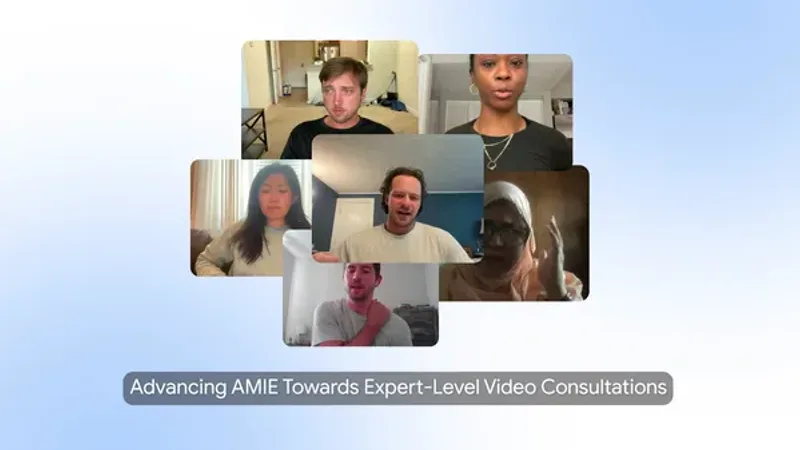
On August 11, 2026, Google Research and Google DeepMind published a first-of-its-kind study showing that AMIE — their Articulate Medical Intelligence Explorer research system — can now conduct real-time video consultations, interpret visual and auditory clinical cues, guide virtual physical examinations, and reason diagnostically as the conversation unfolds. In a randomized study using patient actors and a comparison group of primary care physicians, clinical evaluators rated AMIE favorably across history-taking thoroughness, diagnostic accuracy, management appropriateness, and communication quality. Patient actors preferred the video experience over AMIE's previous text-only format.
AMIE remains a research system. Google is explicit that more work is needed before any responsible real-world clinical deployment. But what this study demonstrates — that AI can conduct a video medical consultation at a level that compares favorably with primary care physicians, across multiple clinical competencies, in a controlled evaluation — represents a genuinely significant research milestone.
This article explains what AMIE is, what the new video capability adds over previous versions, how the study was designed, what the results mean and do not mean, and why the limitations matter as much as the findings.
Introduction
The gap between a text-based AI medical assistant and an actual clinical consultation is large and specific. It is not just about having more information — it is about what kind of information physicians gather and how.
A patient describes chest pain. The text says "mild discomfort." The video shows them bracing their arm against their side when they shift in the chair. Those two pieces of information point in different directions, and the physician who sees the patient knows something the one who only read the description does not.
This is why real clinical consultations cannot be reduced to text. A cough heard through a phone is different from a cough seen and heard together — the productive quality, the effort behind it, the accompanying posture all contribute to the clinical picture. Gait, facial expression, skin color, breathing pattern, the way a patient holds or avoids moving a limb — these are the signals that physicians spend years learning to notice and interpret.
AMIE's previous iteration handled text-based medical conversations at a level Google's earlier research showed was competitive with primary care physicians. The fundamental limitation was that text is not how clinical medicine actually works. The August 11 study addresses that limitation directly.
Quick Summary
| Detail | Information |
|---|---|
| System | AMIE (Articulate Medical Intelligence Explorer) |
| Developer | Google Research and Google DeepMind |
| Built on | Gemini + Project Astra |
| Architecture | Multi-agent |
| New capability | Real-time video clinical consultation |
| Study type | Randomized, with patient actors and primary care physician comparators |
| Evaluation criteria | History-taking, diagnostic accuracy, management, communication |
| Result | AMIE rated favorably vs primary care physicians across all criteria |
| Patient preference | Video AMIE preferred over text AMIE |
| Current status | Research system only — not clinically deployed |
What AMIE Is
AMIE stands for Articulate Medical Intelligence Explorer. It is a research system developed by Google Research and Google DeepMind specifically for the domain of clinical medicine. The underlying foundation is Gemini — Google's frontier language and multimodal model — combined with Project Astra, Google's real-time multimodal AI capability that enables a system to simultaneously process live video and audio.
The system uses a multi-agent architecture — multiple specialized AI components working together, each handling a different aspect of the consultation. This design allows different agents to focus on different tasks: gathering clinical history, processing visual observations, reasoning about diagnosis, formulating treatment recommendations, and managing the conversational flow of the appointment.
Previous AMIE research demonstrated that a text-only version of the system could conduct medical conversations at a level that compared favorably with primary care physicians. The fundamental gap that study acknowledged was the absence of visual and auditory information — the components of a real consultation that text cannot carry.
What Project Astra Adds to Clinical Medicine
Project Astra is Google's architecture for real-time multimodal AI — systems that can see and hear the world as it happens rather than processing text descriptions of it. In non-medical contexts, Project Astra has been demonstrated in tasks like navigating physical spaces, identifying objects in a live camera feed, and responding to spoken questions while simultaneously observing a scene.
Applied to clinical consultation, Project Astra's real-time capability means AMIE can do what a physician does during a video appointment: observe the patient continuously throughout the conversation rather than analyzing a static image, notice changes in visual or auditory signals as they occur, and integrate those observations into the ongoing diagnostic reasoning in the same moment.
This integration is what makes the clinical video consultation meaningfully different from AMIE analyzing a photograph of a patient. A cough that interrupts a sentence while describing symptoms is different from a described cough. The real-time processing that Project Astra enables is what allows those distinctions to inform clinical reasoning as they happen.
The Study: Design and Results
How It Was Structured
The study was randomized and used simulated consultations with patient actors — trained individuals who portray patients with specific clinical presentations — rather than real patients in real clinical settings. AMIE conducted video consultations with these patient actors. A group of primary care physicians conducted separate consultations with the same or comparable patient actors, providing the comparison benchmark.
External clinical evaluators — not affiliated with either AMIE or the physician participants — assessed the consultations across four core clinical competencies. Using patient actors and external clinical evaluators rather than self-reporting or automated scoring provides a more controlled and externally valid assessment than either approach alone.
What Was Evaluated
The four criteria the clinical evaluators assessed correspond to the foundational skills of a clinical consultation:
History-taking thoroughness measures whether the clinician gathered the relevant information about symptoms, timeline, severity, associated factors, medical history, medications, and other clinical context that a complete diagnostic assessment requires.
Diagnostic accuracy measures whether the clinician correctly identified or appropriately reasoned toward the patient's condition given the information available during the consultation.
Management appropriateness measures whether the proposed plan — investigations, treatments, referrals, follow-up — was appropriate given the diagnosis and the patient's situation.
Communication quality measures whether the clinician communicated clearly, listened effectively, explained information in ways the patient could understand, and managed the consultation in a way that was accessible and humane.
What the Results Say
Clinical evaluators assessed AMIE favorably across all four criteria compared to the primary care physician group. The announcement does not provide specific quantitative scores, stating that AMIE was rated favorably rather than providing percentage or point differentials. The full research paper contains detailed methodology and results — the announcement serves as a summary of the key findings.
Patient actors additionally reported preferring the video consultation experience with AMIE over AMIE's previous text-based consultation format. This preference data addresses a different question from clinical accuracy — whether the experience of a video consultation with AI feels more complete and natural to the patient than a text conversation — and the preference toward video is consistent with the clinical logic that video consultations better approximate the real clinical encounter.
What This Means — and What It Does Not Mean
The framing matters here, and it is worth being precise.
What the study shows is that AMIE, in a randomized study using simulated consultations with patient actors and a group of primary care physicians as the comparison, was rated favorably by clinical evaluators across four core clinical competencies. This is a meaningful research result for a controlled study design.
What the study does not show — and what Google explicitly does not claim — is that AMIE is ready to consult with real patients in real clinical settings. The system was evaluated in controlled simulation using patient actors, not in the messy, variable, high-stakes reality of an actual clinical practice. Real patients are not trained actors. Real clinical presentations are more varied and less predictable than simulated ones. The consequences of a missed diagnosis or an inappropriate management recommendation in a real consultation are not the same as in a research study.
Google's own language is clear on this: AMIE remains a research system, and more research is needed before responsible real-world clinical deployment. This is not a product announcement. It is a demonstration that the technical capability exists and performs at a level that warrants continued development toward eventual clinical application.
Why the Visual and Auditory Dimension Matters So Much
Understanding why this research matters requires understanding what physicians actually do during consultations that text cannot capture.
Gait tells a physician something about musculoskeletal health, neurological function, and pain localization before a single question is asked. Skin color and texture are visible — pallor, jaundice, rashes, and nail changes all contribute to diagnostic reasoning and none of them can be described accurately by an untrained patient. Breathing effort, quality, and rhythm are both visible and audible. The way a patient responds to a question about pain while they are sitting differently than when they were standing reveals something that the verbal answer alone does not. Facial expression during a specific range of motion test is clinical information.
All of this is what physicians mean when they talk about clinical observation as a skill that takes years to develop — not the knowledge of what to look for, but the trained attention that actually notices it in real time during a conversation with a stressed, often frightened, person.
What AMIE's video capability represents is the application of Gemini's reasoning and Project Astra's real-time multimodal processing to exactly this problem. The system is not just hearing a description of a cough — it is seeing and hearing the cough, in context, during a conversation about the symptoms it accompanies.
The Road From Research to Clinical Reality
The path between a favorable research result in simulated consultations and responsible deployment in real clinical medicine is long, documented, and appropriately demanding.
Medical AI systems face a level of regulatory and ethical scrutiny that most AI applications do not. Clinical trials, validation across diverse patient populations, assessment of performance on edge cases and rare presentations, regulatory review, integration with existing clinical workflows, liability frameworks for AI-assisted or AI-led diagnosis, privacy architecture for medical data — all of these are genuine requirements that lie between AMIE's current demonstration and any real clinical deployment.
Google's explicit statement that more research is needed before responsible real-world clinical deployment is not hedging for public relations purposes. It is an accurate description of what the research community and the regulatory environment genuinely require before an AI system is trusted with patient care.
The significance of the August 11 result is not that AMIE is ready to be a doctor. It is that the technical foundation for AI that can conduct a video consultation with the multimodal richness of a real clinical encounter has been demonstrated to work at a level that warrants the next phase of research toward eventual responsible deployment.
The Broader Significance for Healthcare
The context in which AMIE research is happening matters. Physician shortages are a genuine and worsening challenge in healthcare systems globally — concentrated in rural areas, in lower-income countries, and in specialties where training pipelines have not kept pace with aging populations. Telemedicine expanded dramatically after 2020 and demonstrated that video consultations can deliver meaningful care — but telemedicine still requires physicians at both ends of the call.
An AI system capable of conducting a clinical video consultation at primary care level, if it clears the research and regulatory pathway to real deployment, represents a potential expansion of medical access rather than a replacement of existing care. The use cases where this matters most are not the hospitals with excellent physician-to-patient ratios — they are the clinics where patients currently wait months for an appointment, the rural communities where the nearest specialist is hours away, and the healthcare systems in lower-income countries where the physician workforce is simply insufficient for the population's needs.
That application is why Google has invested in AMIE as a research priority — and why the August 11 result, even with all of its appropriate caveats about research versus clinical deployment, represents progress worth paying attention to.
Final Takeaway
A randomized study showing that an AI system can conduct a video clinical consultation and be rated favorably against primary care physicians across history-taking, diagnostic accuracy, management appropriateness, and communication quality is a genuinely significant research milestone. It is the first demonstration of expert-level AI capability in real-time clinical video consultation, and the use of Project Astra's multimodal real-time processing is what makes it technically possible.
The limitations are real and honestly stated by Google: patient actors, simulated settings, a research system that is not ready for clinical deployment, and more research required before responsible real-world use. Those limitations are not reasons to dismiss the result — they are reasons to understand it accurately as a research demonstration rather than a clinical announcement.
What August 11 shows is where AMIE is on the road from promising AI research to responsible clinical tool. The road is long. The demonstration that it is the right road, and that the technical capability to travel it exists, is what this study provides.