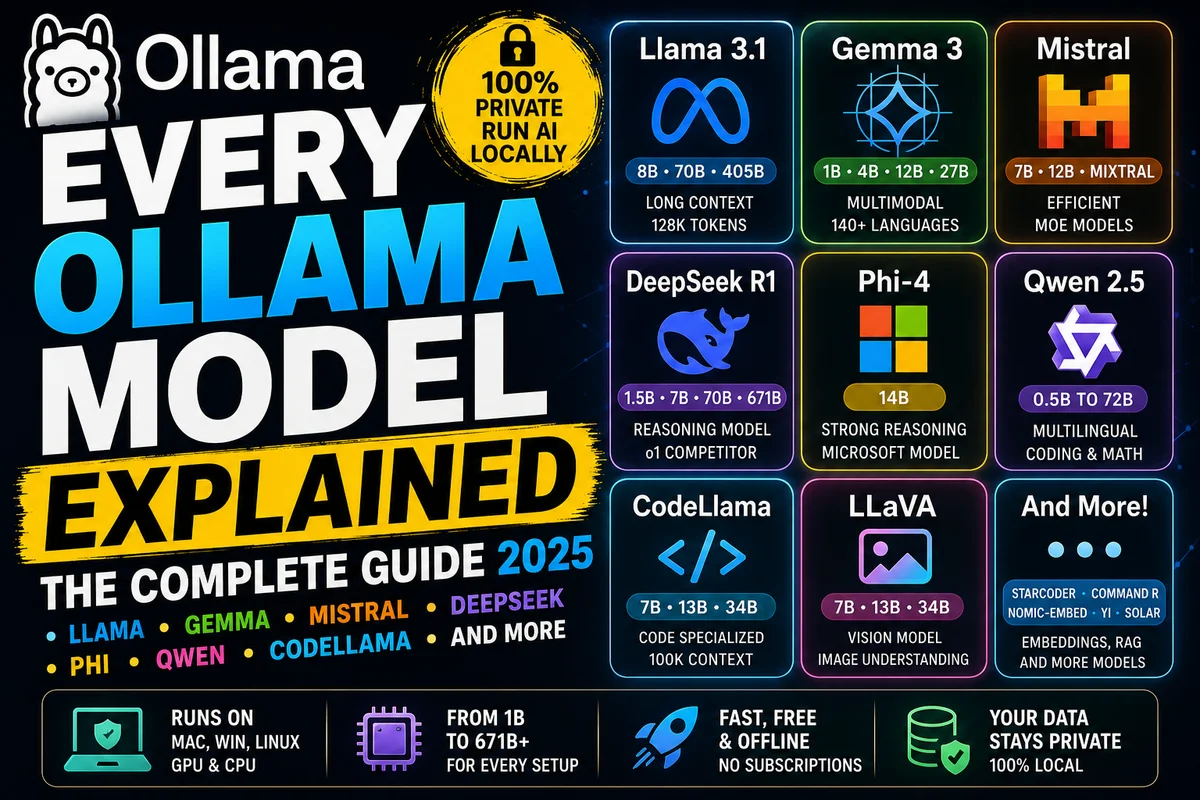
Ollama brings frontier AI to your own machine — no subscriptions, no data uploads, no API limits. But with over a hundred models available, knowing which one to run and why is the real challenge. This guide covers every major model family, what each one does, and exactly which hardware you need.
Introduction
For most people, using AI means sending data to a server somewhere, paying a subscription, and accepting that a third party is processing their conversations. Ollama exists to change that equation entirely.
Ollama is a free, open-source tool that lets you download and run large language models directly on your own computer — your laptop, your workstation, your home server. Everything stays local. No internet connection required once a model is downloaded. No usage limits. No monthly fees. Complete privacy.
The challenge is choice. The Ollama model library hosts models from Meta, Google, Mistral AI, Microsoft, Alibaba, DeepSeek, Cohere, and dozens of independent developers. They range from 1-billion-parameter models that run on a basic laptop to 671-billion-parameter systems that require serious hardware. Understanding which model belongs in which situation requires knowing both the model families and your own hardware.
This guide covers all of it.
What Ollama Actually Is — And What It Is Not
This distinction matters before anything else: Ollama does not make AI models.
Ollama is a runtime — a platform that packages, downloads, and runs models that other organizations have built and released as open weights. Think of Ollama the way you think of a media player: it does not create the content, but it makes the content easy to access and use. The models come from Meta, Google DeepMind, Mistral AI, Microsoft Research, Alibaba, DeepSeek, and others. Ollama converts them into an efficient format called GGUF, handles quantization to reduce memory requirements, and gives you a clean command-line interface and local API to interact with them.
What you actually get when you install Ollama:
A tool that runs on macOS, Linux, and Windows
Support for NVIDIA GPUs, AMD GPUs, Apple Silicon, and CPU-only setups
A local REST API at localhost:11434 that is compatible with the OpenAI API format
The ability to run a model with a single command
Complete data privacy — nothing leaves your machine
Understanding Quantization Before You Pick a Model
Every model in Ollama's library is available in quantized form. Quantization reduces the precision of a model's numerical weights, which shrinks the file size and memory requirements at a small cost to output quality. Understanding the levels helps you pick the right tradeoff.
Quantization Level | Quality | RAM Usage | Best For |
|---|---|---|---|
Q2_K | Lowest | Smallest | Extreme memory constraints |
Q4_0 | Good | Low | General use, default for many models |
Q4_K_M | Good to very good | Low to moderate | Most recommended default |
Q5_K_M | Very good | Moderate | When quality matters more than size |
Q6_K | Near full quality | Moderate to high | High quality local inference |
Q8_0 | Excellent | High | Near-full precision |
FP16 | Full precision | Largest | Research, maximum quality |
When you run ollama run llama3.1:8b, Ollama picks a sensible default quantization automatically. When you want to specify, you can pass the full tag: ollama run llama3.1:8b-instruct-q4_K_M.
Hardware Requirements: What Your Machine Can Actually Run
Before choosing any model, match it against your available memory.
Model Size | RAM Required | Practical Devices |
|---|---|---|
1B to 3B parameters | 2 to 4 GB | Almost any laptop or desktop |
7B parameters | 4 to 8 GB | Most modern laptops with 8GB+ RAM |
13B parameters | 8 to 16 GB | Laptops with 16GB RAM or better |
30B to 34B parameters | 20 to 32 GB | High-end workstations, Mac Studio |
70B parameters | 40 to 64 GB | Mac Pro, multi-GPU workstations |
405B and above | 200 GB+ | Multi-GPU server hardware |
Apple Silicon Macs (M1, M2, M3, M4) have a meaningful advantage here because they use unified memory — the same pool serves both CPU and GPU tasks. A MacBook Pro with 32GB of unified memory runs a 13B model efficiently in a way that a Windows laptop with 32GB of system RAM but only 8GB of VRAM cannot. An M2 Ultra with 192GB of unified memory can run a 70B model comfortably.
On NVIDIA hardware, VRAM is the binding constraint. An RTX 3080 with 10GB VRAM runs 7B models well. An RTX 4090 with 24GB VRAM handles 30B quantized models. For 70B, you need either an A100 (80GB) or multiple consumer GPUs.
CPU-only inference works but is significantly slower — acceptable for 7B models if patience is available, impractical for anything above 13B.
Part One: The Llama Family — Meta's Open-Weight Models
Meta's Llama family is the most widely used open-weight model series in the world and the foundation of a large portion of the fine-tuned community models available on Ollama.
Llama Family Overview
Model | Sizes Available | Context Window | Key Trait |
|---|---|---|---|
Llama 2 | 7B, 13B, 70B | 4K tokens | Foundation for many fine-tunes |
Llama 3 | 8B, 70B | 8K tokens | Strong general capability |
Llama 3.1 | 8B, 70B, 405B | 128K tokens | Long context, multilingual |
Llama 3.2 | 1B, 3B | 128K tokens | Lightweight, on-device |
Llama 3.2 Vision | 11B, 90B | 128K tokens | First Llama with image input |
Llama 2
Released: July 2023 Sizes: 7B, 13B, 70B Context: 4K tokens
The model that established Meta as a serious player in the open-weight space. Llama 2 was released with a permissive license that allowed commercial use for most organizations, which made it the default starting point for hundreds of fine-tuning projects. The 7B and 13B sizes are widely used as base models — community fine-tunes like Vicuna, Orca, and many others are all built on top of Llama 2. Its 4K context window is its main limitation, but for fine-tuning and experimentation it remains relevant.
Llama 3
Released: April 2024 Sizes: 8B, 70B Context: 8K tokens
A substantial capability jump over Llama 2. Llama 3 was trained on a significantly larger and better-quality dataset, producing models that outperformed Llama 2 across reasoning, coding, and instruction following. The 8B model in particular offered surprisingly strong performance at a size that runs comfortably on most developer machines. At launch, Llama 3 8B was competitive with models twice its size from earlier generations.
Llama 3.1
Released: July 2024 Sizes: 8B, 70B, 405B Context: 128K tokens
The context window expansion from 8K to 128K tokens was the defining upgrade of Llama 3.1. Long documents, extended conversations, and large code repositories now fit in a single pass. The 405B variant is Meta's largest publicly released model and competes with GPT-4-class systems on several benchmarks, though running it requires substantial infrastructure. For most developers, Llama 3.1 8B at 128K context is the sweet spot — powerful enough for production use cases and light enough to run on a modern laptop with adequate RAM.
Llama 3.2
Released: September 2024 Sizes: 1B, 3B Context: 128K tokens
Designed specifically for the lightest-weight deployment scenarios — phones, edge devices, embedded applications. The 1B model runs on hardware with as little as 2GB of available memory. Despite their size, both variants carry the 128K context window introduced in 3.1. Llama 3.2 supports eight languages: English, German, French, Italian, Portuguese, Hindi, Spanish, and Thai.
Llama 3.2 Vision
Released: October 2024 Sizes: 11B, 90B Context: 128K tokens
The first Llama model with image input capability. Llama 3.2 Vision can analyze photographs, diagrams, charts, and screenshots alongside text — opening up use cases like visual question answering, document understanding from images, and multimodal chatbots. The 11B variant is accessible to developers with 16GB of unified memory or GPU VRAM. The 90B model requires more substantial hardware but delivers stronger vision performance.
Part Two: The Gemma Family — Google DeepMind's Open Models
The Gemma family is Google DeepMind's open-weight contribution — models derived from the same research that produced Gemini, released under the Apache 2.0 license.
Gemma Overview
Model | Sizes | Context | Key Trait |
|---|---|---|---|
Gemma | 2B, 7B | 8K | First release, strong for size |
Gemma 2 | 2B, 9B, 27B | 8K | Knowledge distillation, better benchmarks |
Gemma 3 | 1B, 4B, 12B, 27B | 128K | Multimodal, 140+ language pretrain |
Gemma
Released: February 2024 Sizes: 2B, 7B Context: 8K tokens
The first open-weight release from Google DeepMind. Gemma immediately demonstrated that Google's research could produce competitive open models — both the 2B and 7B variants outperformed comparable-size models from other organizations on standard benchmarks. The instruction-tuned variants were immediately useful for application building, while the base models gave researchers a strong starting point for fine-tuning.
Gemma 2
Released: June 2024 Sizes: 2B, 9B, 27B Context: 8K tokens
Gemma 2 applied knowledge distillation — transferring capability from a larger teacher model into a smaller student — to produce models that significantly outperformed their parameter count. The 27B variant in particular demonstrated performance competitive with much larger models from other families. Gemma 2 also used an interleaved local and global attention architecture for more efficient handling of sequences. The 9B model became a popular choice for developers who needed strong performance without the hardware demands of 70B-class models.
Gemma 3
Released: March 2025 Sizes: 1B, 4B, 12B, 27B Context: 128K tokens
The most capable and feature-rich open-weight Gemma release. Three improvements stand out. First, the context window expanded from 8K to 128K tokens across all sizes. Second, multimodal capability arrived — the 4B, 12B, and 27B variants all accept image inputs alongside text. Third, language coverage expanded to support over 35 languages out of the box, with pre-training across more than 140 languages.
The 1B model is small enough for genuine on-device deployment. The 27B model outperforms models significantly larger than itself on several benchmarks, making it one of the strongest open-weight options available for developers with access to 20–32GB of memory.
Part Three: The Mistral Family — European Efficiency Champions
Mistral AI, the French AI startup, built a reputation on producing models that punch significantly above their parameter weight. Their models are a staple of the Ollama library.
Mistral and Mixtral Overview
Model | Size | Context | Architecture | Key Trait |
|---|---|---|---|---|
Mistral | 7B | 32K | Dense | Outperforms Llama 2 13B |
Mistral Nemo | 12B | 128K | Dense | NVIDIA collaboration, multilingual |
Mistral Small | 22B | — | Dense | Balanced performance |
Mistral Large | Large | — | Dense | Most capable Mistral |
Mixtral 8x7B | 47B total, 13B active | 32K | MoE | Large-model quality, 13B cost |
Mixtral 8x22B | 141B total, 39B active | 65K | MoE | Most capable Mixtral |
Mistral 7B
Released: September 2023 Size: 7B Context: 32K tokens
The model that announced Mistral AI to the world. On its release, Mistral 7B outperformed Llama 2 13B on most benchmarks — a smaller model beating a larger one by a meaningful margin. It uses sliding window attention, which handles longer contexts more efficiently than standard attention mechanisms. Mistral 7B remains one of the most popular models in the Ollama library because of its combination of speed, quality, and low memory requirements. It runs well on any machine with 8GB of RAM.
Mistral Nemo
Released: July 2024 Size: 12B Context: 128K tokens
A collaboration between Mistral AI and NVIDIA. At 12B parameters and 128K context, Mistral Nemo sits at an interesting point in the size curve — capable enough for demanding tasks, small enough to run on hardware with 16GB of memory. Its multilingual capabilities are notably strong, making it a practical choice for applications serving users in multiple languages.
Mixtral 8x7B
Released: December 2023 Total parameters: 47B Active parameters per token: approximately 13B Context: 32K tokens
Mixtral brought Mixture-of-Experts architecture to the open-weight community at a time when most accessible models were still dense. With 47B total parameters but only about 13B active during any individual inference call, Mixtral delivers reasoning quality closer to a 47B model at the computational cost of a 13B model. The result outperforms Llama 2 70B on many benchmarks while being practical to run on hardware that would struggle with a true 47B model. For developers who want strong performance without extreme hardware, Mixtral 8x7B remains one of the most compelling choices in the library.
Mixtral 8x22B
Released: April 2024 Total parameters: 141B Active parameters per token: approximately 39B Context: 65K tokens
The most capable Mixtral model. With 141B total parameters and roughly 39B active per token, it delivers flagship-class reasoning and knowledge at a fraction of the compute cost of a true 141B dense model. The 65K context window covers most professional document and code analysis tasks. Running it requires substantial memory — 48GB or more — but for developers with high-end workstations or servers, it represents one of the most cost-effective paths to near-frontier capability.
Part Four: The Phi Family — Microsoft's Small But Mighty Models
Microsoft Research's Phi family proved a point that few believed before it: a model trained on carefully curated, high-quality data can outperform models many times its size on reasoning benchmarks.
Phi Family Overview
Model | Size | Context | Key Trait |
|---|---|---|---|
Phi | 2.7B | 2K | Original, surprising reasoning |
Phi-3 Mini | 3.8B | 4K to 128K | Strong small model |
Phi-3 Small | 7B | 128K | Better reasoning than size suggests |
Phi-3 Medium | 14B | 128K | Strongest Phi-3 |
Phi-3.5 Mini | 3.8B | 128K | Multilingual upgrade |
Phi-4 | 14B | 16K | Current Microsoft Research flagship |
Phi and Phi-3
Phi released: 2023 Phi-3 released: 2024 Sizes: 2.7B (Phi), 3.8B, 7B, 14B (Phi-3)
The original Phi demonstrated that a 2.7B model trained on textbook-quality data could match the reasoning performance of much larger models on targeted benchmarks. Phi-3 expanded on this with three size options — mini at 3.8B, small at 7B, and medium at 14B — all trained with the same data-quality-first philosophy. The 3.8B Phi-3 Mini with 128K context is particularly useful for developers who need long-context capability on severely memory-constrained hardware.
Phi-4
Released: December 2024 Size: 14B Context: 16K tokens
Microsoft Research's current flagship small model. Phi-4 at 14B parameters outperforms significantly larger models on reasoning and math benchmarks, continuing the Phi family's tradition of overperforming relative to size. It uses a combination of synthetic data generation and careful data curation during training, which produces strong logical reasoning even at this scale. For developers who want near-30B quality on hardware that can only support 14B, Phi-4 is the most direct answer.
Part Five: The Qwen Family — Alibaba's Multilingual Powerhouses
Alibaba's Qwen family is one of the most comprehensive model lineups available through Ollama, spanning general language, code, and mathematics across an unusually wide range of sizes.
Qwen Overview
Model | Sizes | Context | Specialty |
|---|---|---|---|
Qwen 2 | 0.5B to 72B | 128K | Strong multilingual general model |
Qwen 2.5 | 0.5B to 72B | 128K | Improved coding and math |
Qwen 2.5 Coder | 0.5B to 32B | 128K | 92 programming languages |
Qwen 2.5 Math | 1.5B, 7B, 72B | 128K | Chain-of-thought math reasoning |
Qwen 2 and Qwen 2.5
Qwen 2 released: 2024 Qwen 2.5 released: September 2024 Sizes: 0.5B, 1.5B, 3B, 7B, 14B, 32B, 72B Context: 128K tokens
The breadth of the Qwen size range is notable — from a 0.5B model that runs on nearly any hardware to a 72B flagship that competes with the strongest open-weight models available. Qwen 2.5 improved significantly on Qwen 2 in coding and mathematics, and both generations support 29 languages with strong multilingual performance that makes them particularly useful for non-English applications. The 57B Mixture-of-Experts variant in Qwen 2 offers strong capability at reduced active-parameter cost.
Qwen 2.5 Coder
Released: November 2024 Sizes: 0.5B, 1.5B, 3B, 7B, 14B, 32B Context: 128K tokens Languages supported: 92 programming languages
The most code-specialized model in the Qwen family and one of the strongest open-weight coding models available. Support for 92 programming languages is the widest coverage of any locally runnable model. On HumanEval and MBPP benchmarks — the standard evaluations for AI coding capability — Qwen 2.5 Coder competes with models twice its parameter count. The 7B variant is particularly popular: strong enough for real coding tasks, light enough to run on a machine with 8GB of GPU memory.
Qwen 2.5 Math
Sizes: 1.5B, 7B, 72B Context: 128K tokens
A mathematics-specialized variant that uses chain-of-thought reasoning to work through problems step by step before delivering answers. Mathematical reasoning is one of the most reliable ways to expose a model's logical consistency, and Qwen 2.5 Math's dedicated training on mathematical content produces significantly better results than general-purpose models of the same size on computation-heavy tasks.
Part Six: The DeepSeek Family — The Models That Shocked the Industry
DeepSeek AI, a Chinese AI research company, released a series of models in late 2024 and early 2025 that caused genuine disruption. Their models matched or exceeded GPT-4-class performance at a fraction of the reported training cost — and released them as open weights under the MIT license.
DeepSeek Overview
Model | Size | Architecture | Key Trait |
|---|---|---|---|
DeepSeek V2 | Large MoE | MoE | Cost-efficient general model |
DeepSeek V3 | 671B total, 37B active | MoE | GPT-4 class at far lower training cost |
DeepSeek Coder V2 | 236B total, 21B active | MoE | Strong code generation |
DeepSeek R1 | 1.5B to 671B | Dense and distilled | Reasoning model, o1 competitive |
DeepSeek V3
Released: December 2024 Total parameters: 671B Active parameters per token: 37B Context: 128K tokens
When DeepSeek released V3, the headline was not just its capability — it was its training cost. DeepSeek reported training V3 at a fraction of what comparable Western models cost to train, which raised serious questions about efficiency assumptions in the field. The model itself, with 671B total parameters but only 37B active per token via MoE architecture, delivers performance competitive with GPT-4-class systems on coding, math, and reasoning benchmarks. Running it locally requires very substantial hardware due to its size, but it is available through Ollama for teams with the infrastructure to support it.
DeepSeek R1
Released: January 2025 Sizes: 1.5B, 7B, 8B, 14B, 32B, 70B, 671B Context: 128K tokens
The model that generated the most industry attention. DeepSeek R1 is a reasoning model — like OpenAI's o1 series, it thinks through problems step by step before producing a final answer. On several benchmarks it performs competitively with o1, but it is open-weight under the MIT license and available locally through Ollama. This combination was unprecedented: frontier-class reasoning at full open access.
The distilled variants — 1.5B through 70B — are derived from the full 671B model and transfer its reasoning capability into much smaller and more accessible sizes. DeepSeek R1 7B runs on a machine with 8GB of memory and still demonstrates reasoning behavior that smaller general-purpose models cannot replicate. For developers who want local reasoning capability without server-class hardware, the distilled R1 variants are among the most significant additions to the Ollama library.
Part Seven: The Command Family — Cohere's RAG-Optimized Models
Cohere's Command models are built specifically for enterprise use cases, with particular strength in Retrieval-Augmented Generation workflows.
Model | Size | Context | Key Trait |
|---|---|---|---|
Command R | 35B | 128K | RAG-optimized, tool use |
Command R Plus | 104B | 128K | Most capable Command model |
Command R and Command R Plus
Sizes: 35B (Command R), 104B (Command R Plus) Context: 128K tokens
Where most models are general-purpose tools adapted to RAG workflows by developers, Command R was designed from the ground up with retrieval-augmented generation as the primary use case. It understands grounding — the task of answering questions based on retrieved documents while accurately attributing which document contains what information. This makes it particularly valuable for enterprise knowledge management, customer support systems, and document Q&A applications. Command R Plus at 104B is the most capable variant and one of the larger models available through Ollama.
Part Eight: Code-Specialized Models
Beyond the code capabilities built into general models, Ollama hosts several models built exclusively for software development tasks.
CodeLlama
Built on: Llama 2 Sizes: 7B, 13B, 34B, 70B Context: 100K tokens Languages: Python, C++, Java, PHP, TypeScript, C#, Bash
Meta's code-specialized fine-tune of Llama 2. CodeLlama variants include base (code completion), instruct (instruction following for coding tasks), and Python-specialized versions. The 100K context window is large enough to hold substantial codebases in a single pass. CodeLlama 34B delivers strong code generation quality that, at the time of its release, was competitive with proprietary coding models.
StarCoder 2
Developer: BigCode (HuggingFace and ServiceNow) Sizes: 3B, 7B, 15B Context: 16K tokens Languages: 600+ programming languages
StarCoder 2 covers an extraordinary breadth of programming languages — over 600, including many niche and domain-specific languages that other models have never seen. Trained on The Stack v2, a curated dataset of permissively licensed code, it is designed specifically for code completion and generation tasks. The 15B variant delivers strong performance while remaining runnable on hardware with 16–20GB of memory.
Part Nine: Vision and Multimodal Models
For tasks that involve analyzing images alongside text, Ollama supports several locally runnable multimodal models.
Model | Size | Based On | Key Trait |
|---|---|---|---|
LLaVA | 7B, 13B, 34B | Llama plus CLIP | Most widely used local vision model |
LLaVA-Phi3 | 3.8B | Phi-3 plus LLaVA | Lightweight vision |
BakLLaVA | 7B | Mistral plus LLaVA | Stronger base than LLaVA 7B |
Moondream | 1.8B | Custom | Ultra-lightweight edge vision |
LLaVA
Full name: Large Language and Vision Assistant Sizes: 7B, 13B, 34B Architecture: Llama language model plus CLIP vision encoder
LLaVA is the most widely used locally runnable vision-language model. It combines Llama's language capability with CLIP's visual encoding to handle image understanding, visual question answering, and image description tasks. The 7B variant runs on machines with 8GB of memory and handles most practical vision tasks well. The 34B variant delivers significantly stronger performance for complex visual reasoning.
Moondream
Size: 1.8B Design: Ultra-lightweight edge vision model
At 1.8B parameters, Moondream is designed for scenarios where even 7B models are too large — embedded systems, edge devices, and applications where memory is critically constrained. Despite its size, it handles basic image captioning and visual question answering, making it the only practical option for vision capability on very limited hardware.
Part Ten: Embedding Models
Embedding models convert text into numerical vectors for use in semantic search, RAG pipelines, and similarity matching. These run locally through Ollama alongside conversational models.
Model | Context | Best For |
|---|---|---|
nomic-embed-text | 8192 tokens | RAG, semantic search, general embeddings |
mxbai-embed-large | — | High-quality embeddings, strong benchmarks |
all-minilm | Small | Fast, high-volume embedding tasks |
Embedding models are essential for any developer building a RAG system locally. Instead of sending documents to an external embedding API, you run nomic-embed-text or mxbai-embed-large through Ollama to generate vectors entirely on your own hardware.
Part Eleven: Other Notable Models
Yi (01.AI)
Sizes: 6B, 9B, 34B Context: Up to 200K tokens
Built by 01.AI, Yi models offer one of the longest context windows among locally runnable models — up to 200K tokens on the 34B variant. Strong multilingual capability makes them particularly useful for applications processing long documents in multiple languages.
Solar (Upstage)
Size: 10.7B Context: 4096 tokens
Upstage's Solar 10.7B consistently outperforms its parameter count on reasoning and knowledge tasks. It was built using a technique called depth-upscaling that merges layers from pre-trained models rather than training from scratch, producing a capable 10.7B model that runs comfortably on most development machines with 16GB RAM.
TinyLlama
Size: 1.1B
A 1.1B model trained continuously on a large token budget to maximize what a very small model can learn. Practically useful for testing pipelines, rapid prototyping, and deployment scenarios where even 3B models are too large. Not suitable for complex tasks but surprisingly coherent for its size.
Nous Hermes 2
Based on: Mixtral and Llama variants Key trait: Strong instruction following for agentic tasks
A popular fine-tune series from Nous Research known for strong performance on agentic and multi-step tasks. Nous Hermes 2 models are widely used by developers building autonomous agents and tool-using systems that need reliable instruction adherence.
OpenChat
Based on: Llama Training: C-RLFT (Conditioned Reinforcement Learning from Fine-Tuning)
OpenChat uses a training approach that improves conversation quality by conditioning on feedback quality rather than just preference labels. The result is a model with notably strong conversation coherence compared to standard instruction-tuned models of similar size.
Choosing the Right Ollama Model: A Practical Guide
Your Goal | Recommended Model | Why |
|---|---|---|
General conversation and writing | Llama 3.1 8B or Mistral 7B | Fast, capable, runs on most hardware |
Best overall quality on capable hardware | Llama 3.1 70B or Gemma 3 27B | Top-tier open models |
Complex reasoning and math | DeepSeek R1 7B or 14B | Reasoning model locally |
Coding assistance | Qwen 2.5 Coder 7B or CodeLlama 13B | Code-specialized |
600+ language support for code | StarCoder 2 15B | Broadest language coverage |
Image understanding | LLaVA 13B or Llama 3.2 Vision 11B | Multimodal locally |
Ultra-lightweight (under 4GB RAM) | Llama 3.2 1B or TinyLlama | Minimum hardware |
Long documents (100K+ tokens) | Llama 3.1 8B or Mistral Nemo 12B | 128K context locally |
RAG and document retrieval systems | Command R 35B | RAG-optimized architecture |
Multilingual tasks | Qwen 2.5 7B or Gemma 3 4B | Strong non-English performance |
Local embeddings for RAG | nomic-embed-text | Fast, high-quality local embeddings |
MoE efficiency with strong results | Mixtral 8x7B or DeepSeek V3 | Large knowledge, lower active cost |
Math problems and calculations | Qwen 2.5 Math 7B | Math-specialized reasoning |
Why Run Models Locally Through Ollama?
The case for local AI through Ollama comes down to four things that cloud services cannot fully provide:
Privacy: Every conversation, document, and query stays on your machine. For medical data, legal documents, proprietary code, personal journals, or any information that should not leave a device, local inference is the only trustworthy option.
No cost per token: Once a model is downloaded, inference is free regardless of volume. Developers building applications that make thousands of calls per day pay nothing beyond the initial hardware.
No internet dependency: Ollama works offline. Planes, remote locations, restricted networks — the model runs wherever your hardware goes.
Full control: You can modify, fine-tune, and customize models through Ollama's Modelfile system. You can pin specific model versions. You can run multiple models simultaneously. No feature gating, no usage policies applied by a third party.
Final Takeaway
Ollama's library covers nearly every open-weight model worth running — from the lightest 1B models that work on basic hardware to near-frontier systems that challenge the best proprietary AI available. The key to using it well is understanding that the models come from many different organizations with different strengths, and matching each model to the task and hardware it was designed for.
For most developers starting out, Llama 3.1 8B is the natural first stop — strong, fast, and accessible on almost any modern machine. From there, the Mistral family adds efficiency, the DeepSeek R1 distilled models add reasoning capability, Qwen 2.5 Coder adds programming depth, and the LLaVA family adds vision. The combination of all of them, running privately on your own hardware, is what makes Ollama genuinely transformative for developers who want full control of their AI stack.