Microsoft is running two parallel AI strategies simultaneously — building its own research models that punch far above their size, and deploying OpenAI's frontier models across every product it makes. Here is every model, every product, and exactly how it all fits together.
Introduction
Microsoft's position in the AI landscape is unlike any other major technology company. On one side, it has invested more than $13 billion in OpenAI and integrated GPT-4 into virtually every product it sells — from Windows and Office to GitHub and enterprise security tools. On the other side, its own research division has independently produced the Phi family of small language models that routinely outperform models several times their size, along with groundbreaking work in voice cloning, multimodal understanding, and 1-bit neural networks that could reshape what AI runs on in the future.
Understanding Microsoft's AI portfolio requires holding both tracks in mind simultaneously. The Copilot products that hundreds of millions of people use every day run on OpenAI models through Microsoft's exclusive cloud partnership. The Phi models that researchers and developers around the world run locally are Microsoft Research originals, released under MIT licenses and built on a philosophy — that data quality matters more than model size — that has repeatedly proven itself correct.
This guide covers both tracks completely: every Phi model, every Copilot product, every Azure AI service, every research model family, and the foundational contributions that shaped where Microsoft AI stands today.
Microsoft's AI at a Glance
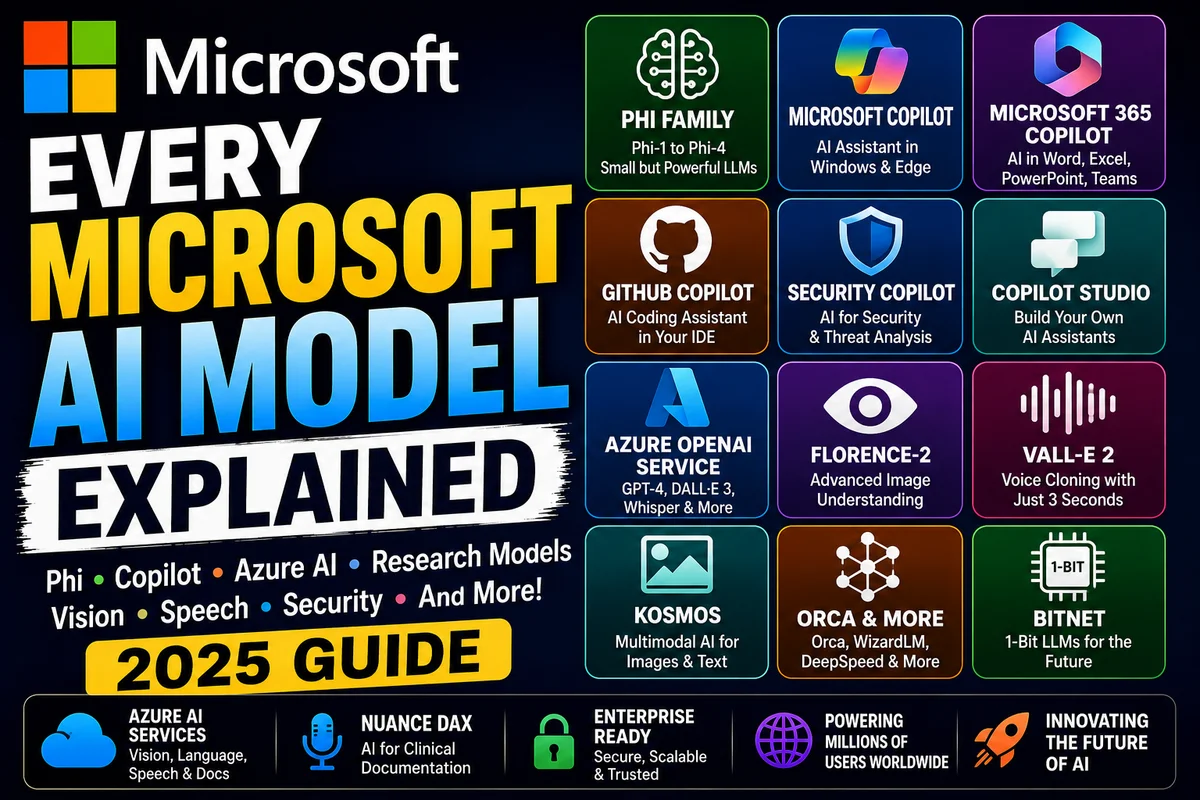
Model Family | Type | Open Source | Key Characteristic |
|---|---|---|---|
Phi-1 to Phi-4 Multimodal | Small language models | Yes (MIT) | Outperforms models 5x their size |
Microsoft Copilot | AI assistant (consumer) | No | Powered by OpenAI GPT-4, in Windows and Edge |
Microsoft 365 Copilot | AI assistant (enterprise) | No | In Word, Excel, PowerPoint, Outlook, Teams |
GitHub Copilot | AI coding assistant | No | Code completion and generation in IDEs |
Security Copilot | AI security analyst | No | Threat investigation and incident response |
Copilot Studio | Custom copilot builder | No | Low-code enterprise AI assistant creation |
Azure OpenAI Service | Cloud AI API | No | Enterprise GPT-4, DALL-E 3, Whisper access |
Florence and Florence-2 | Vision foundation models | Yes (Florence-2) | Universal image understanding |
VALL-E family | Voice cloning TTS | No (research) | Voice cloning from 3-second audio |
Kosmos family | Multimodal research | No (research) | Image grounding and document understanding |
Orca and Orca 2 | Research LLMs | Partial | Learning reasoning from GPT-4 explanations |
WizardLM family | Research fine-tunes | Partial | Evolving instruction complexity |
BitNet b1.58 | 1-bit LLM research | Research | LLMs at 1-bit precision |
Azure AI Services | Cloud AI APIs | No | Vision, language, speech, document AI |
Nuance DAX | Healthcare AI | No | Clinical documentation from conversations |
Part One: The Phi Family — Small Models That Think Big
The Phi series is Microsoft Research's most significant original contribution to the AI landscape, and it is built on a single insight that contradicted the prevailing wisdom of 2023: the quality of training data matters more than the quantity of parameters.
While the rest of the industry was scaling models to hundreds of billions of parameters, Microsoft Research asked a different question — what happens if you train a small model exclusively on the highest-quality material available? The answer, repeated across every Phi generation, is that a carefully trained small model consistently outperforms larger models that learned from noisier, less curated data.
Complete Phi Family Overview
Model | Released | Parameters | Context | Key Advance |
|---|---|---|---|---|
Phi-1 | June 2023 | 1.3B | — | Python coding, textbook data philosophy |
Phi-1.5 | September 2023 | 1.3B | — | Reasoning and language expanded |
Phi-2 | December 2023 | 2.7B | 2K | Beats 13B models on many benchmarks |
Phi-3 Mini | April 2024 | 3.8B | 4K to 128K | First Phi-3, runs on iPhone |
Phi-3 Small | May 2024 | 7B | 8K to 128K | Multilingual, stronger math |
Phi-3 Medium | May 2024 | 14B | 4K to 128K | Best Phi-3 overall |
Phi-3.5 Mini | August 2024 | 3.8B | 128K | 20+ languages, mobile optimized |
Phi-3.5 MoE | August 2024 | 41.9B total, 6.6B active | 128K | Large-model quality at small cost |
Phi-3.5 Vision | August 2024 | 4.2B | 128K | First Phi with image input |
Phi-4 | December 2024 | 14B | 16K | Beats GPT-4o mini on reasoning |
Phi-4 Mini | 2025 | 3.8B | — | Efficient Phi-4 variant |
Phi-4 Multimodal | 2025 | 5.6B | — | Text, image, and audio input |
Phi-1 — The Proof of Concept
Released: June 2023 Parameters: 1.3B License: MIT Focus: Python coding
Phi-1 was not announced with fanfare. It was a research experiment that produced a result too striking to ignore: a 1.3 billion parameter model trained exclusively on textbook-quality Python tutorials, exercises, and documentation outperformed models five to ten times its size on Python coding benchmarks.
The mechanism behind this was straightforward once identified. Most large models train on vast quantities of internet text that includes enormous amounts of low-quality, repetitive, or misleading content. The model learns from all of it indiscriminately. Phi-1 trained only on the clearest, most instructive coding material available — the equivalent of studying well-written textbooks rather than random internet forums. The result demonstrated that a model with far fewer parameters, given genuinely instructive training data, could reach capabilities that raw scale alone could not match.
This insight — data quality over model size — became the guiding philosophy of the entire Phi lineage.
Phi-1.5 — Expanding the Principle
Released: September 2023 Parameters: 1.3B License: MIT
Phi-1.5 took the same 1.3 billion parameter budget and applied the textbook-quality data philosophy beyond Python coding to general reasoning, common sense understanding, and broader language tasks. The model demonstrated that the quality-over-quantity approach was not specific to coding — it generalized. Phi-1.5 remained competitive with models four to five times its size across a range of standard language benchmarks.
Phi-2 — The 2.7B Overachiever
Released: December 2023 Parameters: 2.7B Context: 2K tokens License: MIT
Phi-2 doubled the parameter count while maintaining the research philosophy, and the results continued to demonstrate the same pattern: a 2.7 billion parameter model matching or outperforming models up to 13 billion parameters on many benchmark categories. For developers looking for a lightweight model that could run locally with minimal hardware requirements while delivering genuinely useful reasoning quality, Phi-2 became one of the most popular choices in the open-source community and a base for numerous fine-tuning projects.
Phi-3 — The On-Device Breakthrough
Phi-3 Mini Released: April 2024 Phi-3 Small and Medium Released: May 2024 Sizes: 3.8B (Mini), 7B (Small), 14B (Medium) License: MIT
The Phi-3 generation made a concrete claim that previous small models could not: Phi-3 Mini at 3.8 billion parameters was capable of running directly on an iPhone. This was not a marketing statement — it was a practical demonstration that language model quality had advanced to the point where on-device inference on consumer mobile hardware was genuinely useful, not just technically possible in a degraded form.
On standard benchmarks, Phi-3 Mini outperformed Llama 3 8B — a model more than twice its size — on several categories. The 7B Phi-3 Small brought stronger multilingual capability and mathematical reasoning. The 14B Phi-3 Medium delivered the best overall performance in the generation, competitive with models three to four times its parameter count from other families.
Both the standard (4K context) and long-context (128K context) variants were released, giving developers flexibility for different deployment scenarios.
Phi-3.5 — Three New Directions
Released: August 2024 Variants: Mini, MoE, Vision License: MIT
The Phi-3.5 generation expanded in three simultaneous directions, each addressing a different limitation of the previous generation.
Phi-3.5 Mini upgraded the 3.8 billion parameter form factor with improved multilingual capability across more than 20 languages and better reasoning quality, while maintaining the 128K context window. It remained optimized for mobile and edge deployment.
Phi-3.5 MoE introduced Mixture-of-Experts architecture to the Phi family. With 41.9 billion total parameters but only 6.6 billion active per token, it delivers performance comparable to a large dense model at the inference cost of a much smaller one. This is the same architectural advantage that makes Mistral's Mixtral models practically attractive — knowledge encoded in a large parameter pool, activated selectively and cheaply at inference time.
Phi-3.5 Vision brought image understanding to the Phi family for the first time. At 4.2 billion parameters with a 128K context window, it handles charts, documents, photographs, and screenshots alongside text — making it the first Phi model capable of genuine multimodal reasoning. For developers building document processing or visual analysis applications who need something deployable on constrained hardware, Phi-3.5 Vision filled a gap that required significantly larger models before its release.
Phi-4 — The Current Flagship
Released: December 2024 Parameters: 14B Context: 16K tokens License: MIT
Phi-4 is the most capable model Microsoft Research has released under the Phi name, and it makes the family's case most compellingly. On reasoning benchmarks, Phi-4 at 14 billion parameters outperforms GPT-4o mini — OpenAI's efficient midsize model — on several evaluation categories, particularly in mathematics and STEM reasoning.
The training methodology shifted significantly from previous generations. While earlier Phi models relied heavily on curated real-world educational content, Phi-4 incorporated a large volume of synthetically generated training data — examples created by AI systems specifically designed to develop reasoning and mathematical capability. This approach, producing training material that is more instructive than anything that exists organically, produced results that set a new standard for what a 14 billion parameter model can achieve.
Phi-4 Mini and Phi-4 Multimodal — 2025 Extensions
Phi-4 Mini Parameters: 3.8B Phi-4 Multimodal Parameters: 5.6B
Phi-4 Mini carries the Phi-4 generation's improvements into the smallest practical form factor — 3.8 billion parameters delivering reasoning quality that would have required 13 billion or more parameters just two years earlier.
Phi-4 Multimodal is the most ambitious Phi release to date: a 5.6 billion parameter model that accepts text, images, and audio simultaneously. The addition of audio understanding — hearing as well as seeing and reading — makes Phi-4 Multimodal the first Phi model capable of processing the three primary sensory channels through which people experience information. Its on-device capability means this three-modality understanding can run privately on local hardware without cloud connectivity.
Part Two: The Copilot Family — AI Embedded in Everything Microsoft
While Microsoft Research builds the Phi models as open-weight contributions to the broader AI ecosystem, the Copilot family represents Microsoft's commercial AI strategy: embedding GPT-4-class capability into the products that hundreds of millions of people and organizations already use every day.
Microsoft Copilot — The Consumer AI Assistant
Launched: February 2023 (as Bing Chat), rebranded November 2023 Powered by: OpenAI GPT-4 (via Microsoft's exclusive Azure partnership) Available in: Windows 11, Microsoft Edge, Bing, standalone at copilot.microsoft.com
Microsoft Copilot was the first major product consequence of Microsoft's OpenAI investment becoming visible to ordinary users. Starting as Bing Chat — an AI integrated directly into the Bing search engine — it demonstrated within days of launch that conversational AI could change how people interact with search fundamentally. Rather than returning a list of links, it could synthesize information from multiple sources into a coherent, sourced answer.
The November 2023 rebranding to Copilot signaled Microsoft's broader intent: this was not just a smarter search bar, but the beginning of an AI layer that would extend across the entire Windows and Microsoft ecosystem. The integration into the Windows 11 taskbar made it the first major AI assistant accessible system-wide on the world's most widely used operating system.
Image generation through DALL-E 3 added creative capability to the search and writing functions, making Copilot a multi-purpose tool rather than a single-skill assistant. A free tier with limited usage and Copilot Pro with expanded access provide options for both casual and intensive users.
Microsoft 365 Copilot — AI Inside the Office Suite
Launched: November 2023 (enterprise), broader availability 2024 Powered by: OpenAI GPT-4 Pricing: $30 per user per month, on top of existing Microsoft 365 subscription
Microsoft 365 Copilot represents the most commercially significant AI product deployment in enterprise software history by sheer potential scale. The Microsoft 365 suite — Word, Excel, PowerPoint, Outlook, and Teams — is used by hundreds of millions of people in organizations worldwide. Embedding AI assistance into each application does not require anyone to change their workflow or learn a new tool; it augments the tools they already spend their working days inside.
The specific capabilities in each application are substantively different from each other. In Word, Copilot drafts documents from brief descriptions, rewrites sections in different tones, and summarizes long documents. In Excel, it interprets natural language questions about data — "which product had the highest revenue growth in Q3?" — and responds with the relevant analysis, chart, or formula. In PowerPoint, it generates complete slide decks from a document or text description, handling layout and design alongside content. In Outlook, it reads and summarizes long email threads and drafts replies. In Teams, it transcribes and summarizes meetings in real time, extracting action items and decisions.
The $30 per user per month pricing on top of existing subscriptions makes it a significant purchasing decision for organizations, but the productivity argument — reducing the time spent on drafting, summarizing, and reformatting — is straightforward to quantify in knowledge worker environments.
GitHub Copilot — The AI for Developers
Launched: June 2022 (general availability) Powered by: OpenAI Codex originally, now GPT-4 and newer models Integrated into: VS Code, Visual Studio, JetBrains IDEs, Neovim Users: 1.8 million+ paid subscribers as of 2024 Pricing: $10 per month individual, $19 per month business
GitHub Copilot is the most widely adopted AI coding tool in the world by paid subscriber count, and it has been since its launch. The core function — suggesting the next line or block of code as a developer types — sounds simple but transforms the experience of writing code in ways that users describe as dramatic rather than incremental.
The suggestions are context-aware in the way that matters most for coding: they account for the surrounding code, the programming language, the naming conventions already in use, the imports at the top of the file, and the patterns the developer has established in the current session. A developer does not need to look up syntax for a function they use occasionally — Copilot fills it in. A developer does not need to write boilerplate repeatedly — Copilot generates it from context.
GitHub Copilot Chat extended the tool to conversational interaction: explaining code, suggesting fixes, answering questions about a codebase, and generating tests. GitHub Copilot Workspace, introduced in 2024, moved toward agentic coding — the model takes a described task and generates a plan, makes changes across multiple files, and presents the results for review.
Security Copilot — The AI Security Analyst
Launched: March 2023 (preview), April 2024 (general availability) Powered by: OpenAI GPT-4 plus Microsoft's security data and intelligence feeds Integrates with: Microsoft Defender, Microsoft Sentinel, Microsoft Intune
Security Copilot occupies a category that did not exist before its launch: an AI system that functions as a security analyst assistant, capable of explaining complex threat data in plain language, investigating incidents by pulling together signals from multiple security tools, and generating reports that communicate findings to both technical and executive audiences.
The volume of security data that enterprise security operations centers handle daily is too large for human analysts to process comprehensively. Security Copilot acts as a force multiplier — processing threat intelligence feeds, endpoint alerts, identity anomalies, and network signals simultaneously, then presenting the relevant findings to the analyst who needs to make the response decision. For organizations that struggle to hire enough qualified security personnel, the capability to stretch analyst capacity is practical and immediate.
Copilot Studio — Build Your Own
Launched: 2023
Copilot Studio is the platform for organizations that need AI assistants tailored to their specific workflows, data, and policies rather than the general-purpose capabilities of standard Copilot products. Built on Power Virtual Agents with AI capabilities layered on top, it provides a low-code environment where business users — not just developers — can configure custom AI assistants connected to internal data sources and business systems.
The practical use cases are those where a general AI assistant lacks the context needed to be useful: a customer service agent that knows a company's specific product catalog and return policies, an internal HR assistant that knows the company's benefits structure and processes, or a field service assistant that knows equipment-specific troubleshooting procedures.
Part Three: Azure AI Services — The Cloud AI Platform
Microsoft's Azure AI platform provides the infrastructure layer through which AI capability reaches enterprise customers who need more control over deployment, compliance, and data handling than consumer products provide.
Azure OpenAI Service
Launched: 2022 (preview), 2023 (general availability)
The Azure OpenAI Service gives enterprise customers access to OpenAI models — GPT-4o, GPT-4o mini, GPT-4 Turbo, DALL-E 3, Whisper, embedding models, and the o1 and o3 reasoning series — running on Microsoft's Azure infrastructure rather than OpenAI's own systems.
The enterprise distinction from OpenAI's direct API is significant in practice. Data sent to Azure OpenAI is not used to train OpenAI models. The service comes with enterprise SLAs, compliance certifications for regulated industries, private network deployment options, and integration with the broader Azure security and compliance ecosystem. For healthcare organizations, financial institutions, and government agencies where data residency and processing guarantees are non-negotiable, Azure OpenAI provides a path to GPT-4-class capability within the governance frameworks they already operate under.
Azure AI Vision
Powered by Microsoft's Florence vision foundation model, Azure AI Vision provides image understanding as a managed cloud service. Capabilities include image classification, object detection, optical character recognition (OCR), spatial analysis for physical spaces, and face analysis. Applications built on Azure AI Vision can process images without building or hosting their own computer vision models — the capability is available as an API call with enterprise-grade reliability and scalability.
Azure AI Language
Natural language processing as a service, covering the full range of standard NLP tasks: sentiment analysis, key phrase extraction, named entity recognition, text classification, summarization, and question answering. Azure AI Language powers the Translator service — real-time translation across 100+ languages — and the Text Analytics capabilities used in enterprise applications to understand customer feedback, classify documents, and extract structured information from unstructured text.
Azure AI Speech
Speech-to-text and text-to-speech as a managed service, covering real-time transcription, batch audio processing, neural text-to-speech synthesis with natural-sounding voice output, custom voice model creation, and speaker recognition. The Neural Text-to-Speech capability specifically produces audio that is significantly more natural than traditional synthesis — with appropriate pacing, emphasis, and prosody rather than the flat cadence of older speech synthesis systems.
Azure AI Document Intelligence
Document understanding at enterprise scale. Where general OCR reads text from images, Azure AI Document Intelligence understands document structure — recognizing that a given block of text is a line item total on an invoice, or a signature field on a contract, or a table cell containing a specific data type. Prebuilt models handle common document types (invoices, receipts, tax forms, identity documents, business cards) out of the box. Custom models can be trained for proprietary document formats specific to a particular industry or organization.
Part Four: Microsoft Research Models
Beyond the commercial Copilot products and the Azure platform, Microsoft Research has produced several model families that advance specific technical frontiers, primarily released for research purposes.
Florence and Florence-2 — Vision Foundation Models
Florence released: 2021 (research) Florence-2 released: June 2024 Florence-2 parameters: 0.23B and 0.77B Florence-2 license: MIT
Florence is Microsoft's vision foundation model, trained on large-scale image-text pairs to learn general visual understanding. It powers many of the capabilities in Azure AI Vision behind the scenes, giving the cloud service its image understanding foundation.
Florence-2 was released publicly under MIT license in June 2024 and represents one of the more remarkable efficiency achievements in computer vision. At 0.23 billion and 0.77 billion parameters — tiny by modern AI standards — Florence-2 handles multiple vision tasks from a single unified architecture: image captioning, object detection, visual grounding (connecting text descriptions to specific image regions), and image segmentation. The performance it achieves at these parameter counts substantially exceeds what earlier specialist models of similar size could deliver on any of these tasks individually, let alone all of them from one model.
VALL-E Family — Voice Cloning Research
VALL-E released: January 2023 (research) VALL-E 2 released: June 2024 (research)
VALL-E introduced a capability that sounded like science fiction when it arrived: give the model a three-second audio sample of any person's voice, and it can synthesize that voice speaking any text you provide — preserving not just the voice characteristics but the emotional tone and the acoustic environment of the original recording.
The underlying approach treated text-to-speech as a language modeling problem rather than a signal processing problem. By training on audio codec tokens — compressed representations of speech audio — rather than raw audio waveforms, VALL-E learned to generate speech the same way language models generate text, with dramatically better results than previous synthesis approaches.
VALL-E 2, released in June 2024, became the first text-to-speech system to achieve human parity on standard speech quality benchmarks — meaning evaluators could not reliably distinguish its output from real human speech. VALL-E X extended the capability across languages: it can preserve a speaker's voice identity while translating what they say into a different language they never actually spoke.
Both remain research publications rather than deployed products. The voice cloning capability raises serious misuse concerns that Microsoft has explicitly acknowledged as the reason for keeping them out of public deployment.
Kosmos Family — Multimodal Grounding Research
Kosmos-1 released: February 2023 (research) Kosmos-2 released: June 2023 (research) Kosmos-2.5 released: September 2023 (research)
The Kosmos series explored multimodal AI — systems that understand text, images, and the relationship between them — with a focus on capabilities that go beyond simple image description.
Kosmos-2 introduced grounding: the ability to not just describe an image in words but to point at specific regions of an image that correspond to specific parts of the description. When a model with grounding capability says "the red car on the left," it can simultaneously highlight exactly which pixels in the image constitute that red car. This connects language understanding to spatial visual understanding in a way that basic image captioning cannot.
Kosmos-2.5 specialized in document understanding — reading and interpreting text that appears within images, as in scanned documents, photographs of signs, or screenshots of interfaces. This is a different capability from general OCR: it involves understanding the meaning and structure of text in its visual context, not just reading individual characters.
Orca and Orca 2 — Learning to Reason
Orca released: June 2023 (research paper) Orca 2 released: November 2023 Based on: Llama and Llama 2
The Orca family addressed a question that was live in 2023: if smaller models are fine-tuned on outputs from larger models like GPT-4, can they learn not just what answers to give but how to reason toward those answers?
Standard fine-tuning teaches a model to mimic outputs — what a good answer looks like. Orca's approach exposed the smaller model to the full chain of reasoning that GPT-4 used to reach its answers — the intermediate steps, the considerations weighed, the process of working through a problem. The result was a model that learned reasoning patterns rather than just output patterns.
Orca 2 refined this further with "cautious reasoning" training — teaching the model not just how to reason but when to apply different reasoning strategies. Some problems call for step-by-step logical decomposition. Others are better addressed with direct recall. Orca 2 learned to select the appropriate approach for each type of problem rather than applying a single strategy universally.
WizardLM Family — Evolving Instructions
Released: 2023 (Microsoft Research)
WizardLM introduced a training technique called Evol-Instruct: taking a set of initial instruction-response pairs and systematically evolving them to become progressively more complex and challenging before using them to fine-tune a language model. The approach produces a model with unusually strong instruction-following capability because it trained on a curriculum of increasing difficulty rather than a flat distribution of examples.
WizardCoder applied the same approach to code-specific instruction following. WizardMath used process supervision — rewarding correct reasoning steps rather than just correct final answers — to produce strong mathematical reasoning capability.
BitNet b1.58 — The 1-Bit Future
Released: February 2024 (research paper)
BitNet b1.58 represents one of the most technically interesting research directions in the Microsoft portfolio. Standard neural networks represent their weights as 16-bit or 32-bit floating point numbers — each parameter stores a precise decimal value. BitNet constrains every weight to one of three values: negative one, zero, or positive one. This reduces the memory required to store a model by roughly a factor of sixteen compared to 16-bit precision.
The surprising finding of the research paper is that BitNet b1.58 at the same parameter count as a full-precision model delivers competitive performance — the dramatic reduction in numerical precision does not collapse the model's capability as expected. The implications, if this approach scales to production models, are significant: much larger models could run on much simpler hardware, making AI deployment feasible in environments where current models cannot go.
Part Five: Healthcare AI — Nuance DAX
Nuance acquired: 2022 ($19.7 billion) Product: Nuance DAX (Dragon Ambient eXperience)
The Nuance acquisition brought Microsoft its most consequential real-world AI deployment in a high-stakes domain. Nuance DAX is an AI-powered clinical documentation system deployed in hundreds of hospitals. During a patient appointment, DAX listens to the conversation between doctor and patient, understands the clinical content of what is being discussed, and automatically generates structured clinical notes — history of present illness, assessment, plan, and other standard documentation elements.
The practical impact is direct: physicians spend a significant portion of their working hours on documentation rather than patient care. Clinical notes are legally required, clinically important, and time-consuming to produce. A system that generates them accurately from natural conversation reduces administrative burden and can meaningfully change how much time a physician can spend with patients rather than with paperwork.
Deployed at scale across healthcare systems, Nuance DAX represents the kind of real-world AI impact that benchmark scores cannot capture.
How Microsoft's Two Strategies Work Together
The Phi models and the Copilot products serve different populations and different needs, but they are part of a coherent overall strategy.
The Copilot products — running on OpenAI GPT-4 — reach the broadest possible audience through software people already use. They deliver frontier AI capability to knowledge workers, developers, and security professionals without requiring those users to understand anything about underlying models.
The Phi models serve developers, researchers, and organizations that need to run AI privately, customizing it for specific data or deployment environments where cloud connectivity, cost, or data privacy make the Copilot products unsuitable. By releasing Phi under MIT licenses, Microsoft ensures these users have access to genuinely capable small models they can adapt freely.
The Azure AI platform bridges both: it gives enterprise customers access to OpenAI's frontier models through Azure's compliance and security infrastructure, while also offering access to Phi models, open-source models, and custom model training for organizations that need more control than a standard API provides.
The result is a portfolio that reaches from a 3.8 billion parameter model running on a phone to GPT-4o running in a regulated cloud environment — covering nearly every AI deployment scenario an organization or developer might face.
Microsoft Research's Historical Contributions
The context for everything Microsoft is doing in AI today is a research organization that has been working on AI since 1991 and achieved several landmark results before large language models existed.
In 2016, Microsoft Research achieved human parity on speech recognition — meaning their transcription system matched trained human transcribers on a standard benchmark — for the first time in the history of the field. In 2018, the team achieved human parity on reading comprehension using the Stanford SQuAD benchmark, and separately achieved human parity on machine translation from Chinese to English. In 2019, they reached human parity on conversational speech recognition.
Each of these milestones represented the culmination of years of incremental research, and each announced a new capability threshold. The current generation of products and models builds on this foundation — the Azure AI Speech service draws on decades of speech recognition research, the language understanding in Azure AI Language draws on natural language processing work stretching back years before GPT-4 existed.
Which Microsoft AI Model or Product Should You Use?
For everyday productivity inside Microsoft 365 — writing, analysis, summarization, meeting notes — Microsoft 365 Copilot is the most direct path if your organization has an enterprise subscription.
For coding assistance inside your IDE — GitHub Copilot is the standard choice, with 1.8 million subscribers demonstrating its practical value.
For running a capable language model locally without internet or cloud cost — Phi-4 at 14B is the strongest available, or Phi-3.5 Mini for devices with tight memory constraints.
For multimodal local inference including images and audio — Phi-4 Multimodal handles all three modalities on-device.
For enterprise applications needing GPT-4 capability with compliance guarantees — Azure OpenAI Service is the route, offering the same models as OpenAI's API within Azure's security and compliance infrastructure.
For computer vision tasks as a managed service — Azure AI Vision (Florence-powered) covers the standard enterprise computer vision use cases without self-hosting.
For clinical documentation in healthcare — Nuance DAX represents the most mature, deployed AI documentation system in the market.
For understanding how small models can learn sophisticated reasoning from larger models — Orca 2 and the WizardLM research papers document techniques that have influenced fine-tuning practice across the field.
Final Takeaway
Microsoft's AI portfolio in 2025 is the product of two things working in parallel: a $13 billion strategic bet on OpenAI that gives its products access to the most capable closed models available, and a Microsoft Research program that has independently proven — repeatedly, across every Phi generation — that a small model trained well is more capable than a large model trained carelessly.
The Copilot products bring that combined capability to the places where most professional work happens — Word documents, Excel spreadsheets, developer IDEs, and security operations centers. The Phi models give it to anyone who wants to run AI privately, cheaply, and on their own terms.
Both tracks matter. Neither is sufficient alone. Together, they make Microsoft one of the few organizations in the world with a credible strategy at every level of the AI deployment stack.